Marine Logistics Officer to Risk Manager
Disclaimer: The views expressed by the hosts and guests on this show are their own. They don't represent any branch of service, employer, or organization they're affiliated with.
Listen
Chapters
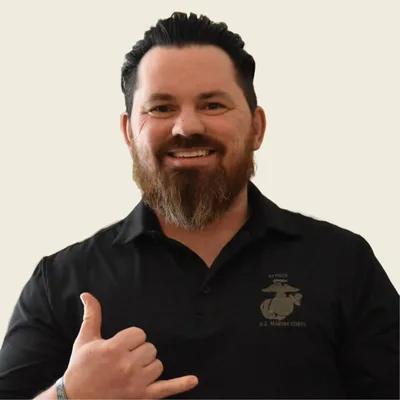
Russ ParkerPMP®
Twenty years in the Marine Corps, from enlisted electro-optical ordnance repair technician to logistics officer, with a deployment to Al Anbar province in 2005 and a tour as an exercise planner in Bahrain. Headed for the lieutenant colonel board when surgery sent him to a medical board instead. Picked up the PMP® after helping his wife study for hers, then the PMI-RMP® a few months later. Now runs Forty-Four Risk PM and teaches both credentials.
Show highlights
- He joined the Young Marines at ten and made first sergeant in it, then kept quiet about that once he was actually in the Marine Corps.
- His father would only sign the paperwork for a seventeen-year-old on one condition. It had to be the reserves, so the college degree still happened.
- His first project was a battery terminal modification on night vision optics across Al Anbar province. He was nineteen, the only man with his job in the battalion, and nobody called it a project.
- He became a logistics officer partly because one told him he wasn't smart enough to do the job.
- He got through the PMP® by translating each question back into the Marine Corps planning process and out again, like working between two languages.
- He copied a friend's operations order for a range using find and replace. His friend's range was in July, his own was in December, and it snowed.
- A thirty-five hour PMP® prep course spends about two and a half hours on risk. A risk course spends thirty.
- The $1.1 billion he saved arrived as an email with the figures in it. He says he sat with it for a couple of days trying to work out what he'd actually done for anyone.
Russ Parker was in the Young Marines from the age of ten. He made first sergeant in it, then kept fairly quiet about that once he was actually in the Marine Corps. His father was a Marine and wanted him to go to Parris Island the way he had himself, but he also wanted the college degree he'd never got, so the deal on offer to a seventeen-year-old was the reserves. Parker enlisted as an electro-optical ordnance repair technician, turned up on day one to a room full of talk about resistors, and had to ask what soldering was. Two years later he was in Al Anbar province as the only man with his job in an infantry battalion, riding convoys from base to base to swap a two-battery terminal for a one-battery terminal on every night vision optic he could reach. He was nineteen. Nobody called it a project, and when he got back they made him write up what he'd learned from it.
The commission came partly because a logistics officer told him he couldn't do the job. He did the job and did it well. By the time he made major and was planning exercises in Bahrain, the closest thing to a career plan had arrived through his wife. She'd done project management for the State Department and was studying for her PMP®, and he sat there quizzing her off flashcards recognizing every concept under a different name. He filed that away for about ten years. Then surgery turned into a run of medical conditions, the lieutenant colonel board turned into a medical board, and he found himself at Wounded Warrior Battalion taking personality tests that came back saying he liked solving problems with people and working methodically toward an end state. The woman running the session asked whether he'd ever thought about project management. He took a scrum course, worked out he'd been running Kanban boards for fifteen years without having the word for it, got the PMP®, and added the PMI-RMP® a few months after that.
The argument he makes is that risk isn't a sliver of project management, it's a discipline that got folded into one. He'll point out that a thirty-five hour PMP® prep course spends about two and a half hours on risk, and that a risk course spends thirty. He thinks most organizations accept risk passively, deciding in advance to write a check if it lands, and never pricing what the second and third order effects cost when it does. What he brought out of the Marine Corps is a vocabulary for stopping: the tactical pause, the maintenance stand-down, the day where nobody moves and everyone looks at the plan instead. The lesson underneath it came from a lieutenant colonel who worked out that Parker had built his operations order by running find and replace over a friend's, and asked how he could be trusted to plan a deployment when he couldn't plan a range. Parker's range was in December. His friend's had been in July. It snowed.
Transcript
AI-assisted transcript, lightly edited. May contain errors.
Hey, everyone. Welcome back to another episode of Veterans in Project Management. Stuart Bell here, joined by Dr.
Michael Shick, as always. Michael, how's it going, buddy?
Hey, Stuart, it's a pleasure seeing you again. I'm particularly excited to,for our guest today, Russell Parker. a- and Russ is a 20-year Marine Corps veteran. Started off as an enlisted s- enlisted optics tech, and then when he earned his commission, became a logistics officer.
And he now owns a, a project management company focusing in on risk, 44Risk. And,w- I'd love to hear his story of his experience in the Marine Corps and then transitioning out and now what he's doing into project management. with that, Russell, if, a- and if it's all right, I'll just call you Russ.
tell us a little bit about yourself. what'd you do in the Marine Corps? If I'm not mistaken, you were an optics tech, when you first started out?
Yeah, so originally I'm from Cleveland, Ohio. My dad was a Marine, so I kinda like always wanted to get into the Marine Corps. So I started actually as a junior ROTC, called the Young Marines.
I joined that when I was 10 years old. So from 10 until I was 18- Oh, wow ... I was in that. I made it to the rank of first sergeant in the Young Marines, and, not a lot of people actually know that. kept that kind of private while I was in. But, yeah, so got into the Marine Corps, and my dad really wanted me to get my college degree.
He never got one, and at the time I was looking at the Naval Academy. I actually had a really good connection to get into the Naval Academy, but then I found out I didn't get to go to Parris Island, and I really wanted to go to Parris Island. That's where my dad went for the Marine Corps. So my dad made me make a d- he made a deal with me and he goes, "All right," he's "You'll sign off on all the paperwork to go to boot camp," 'cause I was 17 at the time.
But he said, "You have to go to the reserves, 'cause I want you to get your degree." So I was like, "All right, cool." So I s- I enlisted into the reserves as a optics tech. Long name is electro-optical ordnance repair technician. Had no idea what that was when I first got into it, and still surprised I even got into the MOS, because I showed up to day one of training and they're talking about, resistors and all these different things that I had no idea what it was.
my first thing I had to do was soldering. I had to solder together a, calcula- a calculator, and-
When the day one whenever we show up and they're like, "Hey, you're gonna have to do this," I'm like, "What's soldering?" The guy goes, "It's soldering." And I was like- ... "Oh, okay. That, okay, what is it?" so but I, and I ended up doing pretty well in MOS. I learned how to solder, I learned how to do a lot of things with electronics that I never would have thought I would have got into in high school.
But- Yeah ... after that I end up, yeah, so deployed to Iraq right away. came back and I was like, "All right, I wanna hit college 'cause I wanna figure out what in the world that was." Study, started studying Middle Eastern studies, but they didn't offer that as a major so I picked the easiest major I could find, which was sociology.
so I got my-
That seems
like a
good balance. Yeah. So I got my degree in sociology, minored in Middle Eastern studies, and from there decided to go get a commission, commissioned and became a logistics officer.
Oh, that's fantastic. it reminds me of when I, enlisted. I started off enlisted in the Air Force and I became a tech controller.
And so this was back in the late '90s when, America Online was still sending out CDs- ... so people could do dial-up. And I was on the internet once, and I, here my a- Air Force specialty code was to manage networks, so router switches, anything from the wall out. So there was th- th... our instructors kept talking about PCs and users, and I started going to the back of the book trying to find out and confirm what I thought a PC was or what a user was.
I kinda feel you when you talk about,soldering.
Yeah. So That, the MOS is, it's so wide too because I worked on everything from just the te- normal night vision you used, all the way up through, the sights and optics on TOW missile systems and the howitzers. Oh, wow.
so it w- it was like a, when I went through, I think it was a seven, eight-month-long school. you learned a lot of different stuff,
Yeah. That, that, that is pretty broad. so what would you say, w- whether it be from your enlisted time or before you became an officer, what w- what's o- one story that really comes to mind to you, about your experience?
was there anything that kinda stood out that, you know- Whether it was to eventually become a logistics officer or,how organizational management works? Was it, or anything that took you by surprise?
So they got me into logistics or got me into project management, which one?
They,I would say,what stood out most just from your time in the M- Marine Corps.
and if it connects to project management, then so be it. Perfect. Yeah. But, if not, it's just something, a lesson that, that you learned, early on.
Oh, man. Yeah, if you wanna go back to the enlisted days, I learned... Going to Iraq was probably where I learned the most. I was, I'd been in the Marine Corps for a year and a half whenever we deployed.
It was 2005,you're talking about, Iraq was still fresh at the time, and we got sent to Helmand province. And while there, I was one of one. I was the only guy with my job in the entire infantry battalion. So my job, I had to go fix everyone's optics. And, and-
R- re- real quick, I'm sorry to, jump in, Russ.
w- were you, are you talking about Iraq or are you talking about Afghanistan? just
so we're clear. Oh, I'm talking... Yeah, I said Helmand. I meant Al Anbar province. Up in- Fantastic ... so we were in Haditha, at the Haditha Dam, right? Got it. This big electro, power dam in the mi- in Iraq. And, yeah, so I had to travel around and do everyone's optics.
And I remember one time there was a... And I always tell people this is my first project I ever got, I think I, I was probably 19, I may have turned 20 already, 'cause I turned 20 while in Iraq. And they're like, "Hey, there's this new modification that came out for one of the optics, where it went from a two battery down to a one battery cell, and you have to replace all these.
And you have..." And when the modifications come out in the Marine Corps, they give you, a timeline. And you have to, "We want you to meet this timeline," or like this. So I'm like, "All right." They're like, "So figure this out." So this is kinda like my initiating order, figure out how I'm gonna do this.
I go back, I have to pull out all these cards. Where are all these optics? I had to me and my sergeant were up on the board. We're, we were pinning, okay, this base has so many, this base has this many. We're trying to figure out where all these optics are for, so we're basically doing some type of planning, and then we developed a overall plan.
Okay, I would jump on convoys and I would go to each base. We would let them know at least a couple days in advance. And that way, when I got there, just consolidated everyone's stuff, did the replacements, and then pushed them back out. And, so yeah, and then I went into execution mode, and I drove all over Al Anbar province just switching out these stupid,
optics, battery terminals, and yeah, that was, it was an adventure, to say the least- Yeah ... getting around to all these different places. And, yeah, like I said, like to some people that's... That was my first project, and I learned, just the, the overall how you take something from planning into execution.
Then when I got back, they made me do all these, little after-action reviews, of what I learned in the process. So it was definitely interesting.
Even without the naming of the, like, all of the project management frameworks, the thing that we hang the hooks on now just to give it some structure to make it easy for people to understand, when you're out in the field, I think just that, there's book learning of the names and passing exams and tests, but the actual in the field doing the job, understanding how the pieces fit together, regardless of what the name is, if you've got that structure, you understand what you're actually trying to achieve, I think it makes it so much easier to go from practitioner to exam rather than exam to practitioner 'cause it's a different part of the brain that you have to engage.
Yeah. how close to the, from the planning, base being out in the field, I've got visions of you turning up and people saying, "No, actually we got rid of those units years ago." How close was it to what you expected when you turned up?
other than,oh, this guy's out on patrol, and this guy, or this thing actually got blown up in IED last week, and stuff like that, it really wasn't too far off.
we kept really good documentation on w- who had what, who had what, it's ideal. but not much was, not much that I remember,we're talking about 21 years ago now. Yes. of that all going down, but I remember it was... it went pretty fluid overall. the convoys, obviously there were delays in convoys, naturally, being Iraq at that time.
And, yeah.
We, Stuart, I know, y- you probably,I know through our conversations you particularly seeing the outcome. Russ, were you able to pull in any data points, even if it was anecdotal, and just hearing from the other, Marines- The positive effects of this upgrade, and we don't need any technical details, but did people i- in the unit actually appreciate the outcome o- of these upgrades?
Yeah. No, the modification was actually really, it was actually good. if anyone looks at it now, I don't, actually, I don't even know if we still use the optic. So it was the, you had the seven Bravos, which was like the two eyes that went into the one optic, but then you had the one optic, right?
That was the PVS-14s.
So on that, w- what we were modifying was there was a two battery terminal, and it had this little plastic clip thing that went on it, and that would always break off, so people would have to put tape and stuff around it to keep it together. What it went to was a one battery terminal that screwed on, right?
Oh. So it was actually really useful because, A, it cut back on how many batteries you needed, and two, it screwed on so that plastic piece kept break- stopped breaking off all the time.
Yeah. and then,depending on what branch you're in,you could be charged if you lost it. So I'm sure, I know, if I had to be accountable for something like that, I'd appreciate if it didn't just randomly fall off.
Or if you get in a fire fight, you're fumbling around with your optics,
Yeah. No, it was-
Pay attention to what you're doing.
Yeah, especially 'cause eventually that, the w- that, the PVS-14, just the one, it really was useful for the guys because, it allowed you to keep your depth perception.
You could still keep one eye not outside the optic. So it was quite useful
Fantastic. so from your enlisted time as an optics tech, and then moving into the logistics, did you find some of the lessons learned that you had from your enlisted days, helped you, on the officer side with your initiating, planning, executing and,monitoring, controlling if we're talking about the PMI framework in closing out projects?
or was there a different approach that you took, on the officer side, versus what you were doing,your experiences in Iraq?
Yeah, I'd say it's, for the planning-wise, I think I did have a little more reception, as in I understood that a lot of the enlisted guys were some subject matter experts.
I always tell people the reason, one, one of the reasons why I even became an officer afterwards is that I did have a captain or lieutenant who said, who basically said I couldn't do his job, and that, I wasn't as smart as he was. And so I did it. and that's half the reason why I became a logistics officer.
He was a logistics officer. I became a logistics officer. And I did his job, and I did it really well. And, but when it came to planning, yeah, obviously we had the Marine Corps planning process, which, if you look is pretty close to overall what PMI teaches. And I d- you know, I think it was Stuart was talking about, the book and being a practitioner before you learn a lot of this PMI stuff.
fast-forward kind of a couple years, I was, I'm a captain, and I met this beautiful woman who decided that she had been doing project management with the State Department, and she wanted to get her PMP. And at the time, I had no idea what it was. And she's like, "I wanna get this certification." I'm like, "That sounds okay, cool.
what do you gotta do?" And she's "I gotta study all these books, and I gotta do all these note cards, and I gotta do all this stuff." And I'm like, "That looks terrible." But being a good,boyfriend/fiancé at the time, I decide hey, I'm gonna help her study. I'm doing these flashcards with her.
I'm d- quizzing her, going through stuff. And as I'm doing it, I'm like, "I know these terms. I just call them different things. I know these concepts. I call them this." and like you said, Stuart, you're like, I knew what these things were. It's just I just called it completely different concepts.
And in turn, that's what got the itch when I realized, okay, this project management thing- Is actually pretty close to what we do. And, I was able to use some of those concepts I learned just from working with her in the planning that I was doing. Because after she got her PMP, I got promoted to major, I ended up becoming an exercise planner over in the country of Bahrain, for the Middle East.
And I kinda got to use a couple of those little small concepts I learned from her. But at the time, watching how miserable it was, I- At the time I was like, "I am never doing that in my life." little did I know 10 years later I would, but
It's funny the introductions that people get into the world. So my, my introduction to it is really on the civilian side coming from IT project management, and the whole certification side in the UK is more around, or at the time was more around PRINCE2 and that, that route.
But the project management framework is so tied into civilian progression through companies that it was very hand-in-hand. So even from a particularly, even from a relatively junior level, people still had that roadmap of certification because it tied in so much with job progression and moving around.
But it's always interesting to hear people come into it from a slightly circuitous route back in, and not necessarily having that, initial goal tied to career outcomes, but coming into it later and really bring in, as you described, all of the practitioner expertise and the, the years and years worth of experience.
some of the y- again, this is like 10, 15 years ago now, but being management on the civilian side, seeing more junior staff come through and helping guide them through the stage, it really was, for some people, pushing on the end of a bit of rope rather than them pulling themselves through, and trying to get people just over that academic barrier of going through it.
Just with so many hurdles, and people were either o- on one end of the spectrum academically very good, but implementation, maybe left a bit to be desired. Yeah. Or on the other side, implementation, they knew the nuts and bolts but just were so hung up on the academic side of it. So it's interesting to see you go round the route of doing the job to getting the exposure, to doing the job again, to doing the certification.
That coming together of all of that experience, did it make the eventual certification a lot easier, or a little easier, or not easier at all?
I think, I think a lot of people that go into that exam, it's not easy. but I think I, the hard part for me was the translation piece. 20 years of just-
indoctrination of the Marine Corps and then eventually the joint planning process. I seriously sat at the PMP and it was like I would translate. So I would read a question, I'd be like, "Okay, it's talking about this," which goes back in my head, goes back to the Marine Corps planning process.
Okay, so and then like I would like translate- ... in my head back and forth.
English, Arabic, English again.
Yeah. Yeah, and it worked for me. Yeah ... I don't know if that works for everybody, but yeah, I think, I don't know if it made anything easier. I don't think, I don't think it made anything harder, it just made it- complicated to the point where I was trying to interpret the information in the way that I understood it.
Yeah.
S- so let me ask you this, Stuart. I'm sorry. let me ask you this, Russ. When you were... you spent your time as a logistics officer, ended up doing a, a full 20, and then, retired out. What's... How did you find yourself going from logistics into project management? It sounds like there was a lot of overlap, at least from a- the planning process.
So what made you say, "Hey, you know what? now that I am, retiring-" I am interested in project management." Did you have a process or did you just stumble into that? I,walk us through on how that happened for you.
Yeah, so for me it was, it was definitely interesting because I wasn't planning on getting out.
I was doing great. and I was supposed to be up on the lieutenant colonel board, but instead I end up having surgery. That surgery resulting in a bunch of new, little adventure of medical conditions. So the Marine Corps's "You're not going on lieutenant colonel board, you're going on a med board."
And, Yeah ... so I quickly had to figure out, what I want to do when I grow up. Like, where do I want to go? And luckily, the Marine Corps was, they offered me the ability, I went out to Wounded Warrior. There's a, we have Wounded Warrior Battalion, which is not like the Wounded Warrior Project.
It's an actual unit in the Marine Corps where if you have medical, you're trying to, figure things out, they're gonna help, they help you out. And so they sent me there, and while there, I went through, their, some of their career programs, and I got linked into, FourBlock, which is a great program out there for anyone transitioning out of the military.
You need to have a college degree to get into it, but if you think of, TAPS or, whatever they're calling the transition class that you have to take, it's like that but on steroids. great program, FourBlock. And then also I worked into the Hiring Our Heroes Corporate Fellowship Program, which is a skill bridge type program that kind of links you into a bunch of industry, different places of industry you get to interview, and then you get to work with them while you wait, while you're n- getting out of the military.
And then that's when I used... Through them is how I got my job that I ended up taking on after I retired. But in that process, I was like, "Okay, what do I want to do?" So I like I said, I was talking to the career people. they sent me through the, what is it? The DISC analysis, and I did the, other personality test, I can't remember what it was.
Like the Myers-Briggs or something to
that effect? Yeah, yeah, one of those, the Myers-Briggs. And it came back that, the big things that I like to do is I like to work with people and solve problems, and I like to, methodically work through a process to, get to the end state.
And the girl there, she's "Have you ever thought about project management?" And I was like, "My wife-"
Ironically enough, huh?
I'm like, "My wife did project management." I'm like, "I don't know." So I ended up, she recommended I take a, I took a CSM course, so the Certified Scrum Master. And in that, it was like, I'm like, "Okay, this is what I do."
the whole m- planning and iterative and pulling people up. I'd realized I'd been using Kanban boards for 15 years and didn't even know it was a Kanban board. I just, I was like, "Okay." So I'm like, "Maybe this PMP thing's not a bad thing." And I made the decision, I'm going to go for this, and that's what I went for.
In that process, I started interviewing with the Hiring Our Heroes. In turn, someone hired me, they offered me, jobs for project management. I was like, "All right, cool." I took it. So I was like, "I have to get this PMP now." and-
Necessity's the mother of invention.
Yeah. So I ended up getting, so I took the PMP, got it.
In that process, I fell in love with the risk management side, because risk management, if you look at PMI's, what PMI teaches for risk management, and if you look at the doctrine of the military, the Marine Corps, and the joint doctrine on risk management- Someone copied someone along the way. through a conversation I had with somebody, they said that, yes, there was a time in, the late '80s or early '90s, I guess it was, where the military and PMI were working on some of this risk management together.
So I'm not too far off there. But yeah, the risk management side, I fell in love with. So after I got my PMP, eventually I, a couple months later, I got my RMP because, like I said, risk is where I, I feel most comfortable with. Because-
Now, just so everybody's tracking, RMP, that's, risk management professional
Risk management professional
correct.
Yeah. Okay. 'Cause
yeah, if
you go, if you go back to when I was a lieutenant,I tell this story all the time, is I got in ch- I was in charge of planning a range, right? I'm a lieutenant, though. At the time, the Iraq or Afghanistan war is, heavy. I'm at a regiment. So I, as a regiment, there's, in Camp Lejeune, North Carolina, there's three ri- infantry regiments.
Under each regiment, there's three to four battalions. each regiment was deploying to Afghanistan, and they would tran- they would tr- you know, transfer with each other. So there was two, six, and eight. And so when two, or when six was there, eight was preparing to go replace six. And then when eight went, two was,preparing to replace eight.
So I was with two. We were considered the reba- remaining behind element at the time. So I end up having seven infantry battalions that I was supporting, while at the same time I had a platoon of Marines that I had to train to go to Afghanistan. And I was busy, so they tasked me with this range because I'm one of the few lieutenants at the regiment level.
They're like, "Hey, Lieutenant, go do this." I'm like, "All right, yeah, I'll do it." Well- I kicked the can down the road to the point where my op order that I had to submit to our operation shop is like, it's due in a couple days. So I phone a friend, and I'm like, "Hey, you ran this range co- didn't you?" And he's like, "Yeah, I ran that range.
It's a simple range." I'm like, "Sweet, send me all your information." He emails it over. I did a Control + F, search find, replace. I took his name, I put my name. I took his unit, I put my unit. I did it like that, made sure everything looked good, crossed the T's, dotted the I's, signed the paper, emailed it over, considered everything done.
I'm like, okay. In the process, I had my Marines doing all the preparation work to make sure the, the range was actually ready to go, but I didn't really do the work really. I just kinda copied someone else's work.
a couple days before the range, I get a phone call from their XO. The XO's a lieutenant colonel.
I'm a lieutenant. He calls me and he's like, "Russ, get over to my office right now," which if you know anything, never a good sign when the lieutenant colonel's calling you to, head to his office. I get in there, and he's like, "You're running the range, next week, right?" I'm like, yes, sir. I got it," and blah, blah, blah.
"We're, everything's set. We got everything we need." And he's just "All right, that's great." He goes, "You wrote this order?" And I'm like, "Yes, sir, I did." He's like, "Okay, cool. What..." he starts asking me random questions, and I'm like, what is he asking me these questions about? he ends up calling me out because in my risk management plan, in the operational order, which is a basically your project plan for how you're going to execute the range I had, the simple stuff.
If, people get overheated, so we're gonna have a cooling tent, we're gonna have plenty of water on site, we're gonna have all these different things. Which is cool, which is something you need in your plan. But the problem was my range was in December. My buddy's range that I copied was in July.
So you're talking about two different environments.
Yes.
So he, he started to call me out on the fact that I didn't, he, he recognized that I didn't do the actual planning. Granted, I had stuff for d- for heat mitigation, to make sure that we had warming stuff for individuals, 'cause yes, it was supposed to be cold.
But the worst part about it was the day of that range, it snowed in North Carolina. Or the day before, it snowed in North Carolina, which made it all worse.
Oh my
goodness, yeah. But he, what he did is he said to me a couple things. He said, one, he goes, "How can I trust you-
to plan or to take your Marines to Afghanistan and do the planning to make sure that they're safe if you can't even plan a simple range?"
And he t- he basically told me without saying it, he just basically said my job was risk management. That's what they paid me for, was to look at what could go wrong and how do I prepare my Marines for it.
Yeah.
And that's what I took forward for, the rest of my officer career, was like, when things came up, I, yes, I had my Marines to do with them, but my job was what is the threat?
Where are the IEDs? where is the historical trend on this route? How has this route been doing the past couple weeks? all these different areas. And then as I continued to grow, that's how I focused on a lot of my life, was like, what are the good, what is the bad that we can have out there, and how do we either take advantage of it or how do we avoid it?
And like I said, when I studied for the PMP and I got to the risk management side, I'm like, "Oh my God, this is like what I do." So-
Try
some of that ... which,
yeah That blend of- Dotting the I's, crossing the T's. The amount of pressure that's on everyone to get everything, everything done within a small amount of time, a smaller budget, more constraints.
Knowing where the attention needs to be, both for the actual work to make sure that the, regardless of what paperwork or what other boxes need ticking, that the underlying where the rubber meets the road work is actually done. But then also having the, transmitting the confidence to everyone else that everything has been done.
So building on that success, but making sure that everyone is aware of that and has the confidence. 'Cause as soon as that lack of confidence creeps in at every level, then that's where the cracks show up and the variations come in, and other people's attention kind of wanes or their detail. So such a, that risk management role is such a balancing act of making sure that the right work is done at the right time, but also that the confidence is communicated through so that everyone else is on the same page and feels, feels that they're supported or that they're, that the outcome's being met.
So really it's that balance of doing the work and doing the work well, but managing the message and making sure that the soft side, I guess that's where the major in your degree comes in a little bit as well, the psychology of people. it's a bit of a balancing act.
So- No, I completely, yeah.
My sociology degree has come into play more, way more than I ever thought it was- ... whenever I was studying it. but yeah, I completely agree. yeah, just the way you look at things, even as project management, in the civilian world, I was in technology. I don't, I'm not a technology guy.
I'm a logistics Marine. we're, Marines, we're not known for being technologists. And but the thing was, I had technology experts just like I did whenever I was in the Marine Corps, and I, they threw me, I was in transportation. I don't know, I don't know a lot of things about the trucks, but my Marines did.
But what I did know was how to make sure that the plan was synthesized with everyone else. I knew how to ask the right questions about what it, "Okay, you're telling me this. H- what happens if that doesn't happen? What do we do?" Okay. And I, and challenging individuals. So that's what I took over to the civilian side whenever I got my job, was like, asking the questions, challenging the plan, and making sure that, A, my team was taken care of, and building the confidence in the leadership that we can actually get this job done even if things didn't look as well as they wanted it to be.
Like- Yeah ... we have plans,
That's, do you see that? Again, three years ago now, so my memory kind of fades on the exact examples of the stories. But having worked with My limited service background and then people who are coming out from full-time, in that civilian space, what we had was the, the and then what or what if type question.
Because the consequences of... And again, I was never deployed, so I don't want to make anyone think that. But being in an environment of known deployed people, working with deployed people, supporting them to a certain degree, and then working with those people, the what if in all of those scenarios, whether you're deployed to a theater or just out on an exercise, the what ifs are pretty consequential, which doesn't translate for people in civilian life all the time.
The what ifs are typically less consequential, unless you're emergency services, Have you found it a struggle or do you see people struggling with that telegraphing of that responsibility? the what if, we need to ask these questions and we need to pressure test it, and we need to ask the what ifs beforehand because we need to, the whole risk management exercise is mitigating all of those.
Is that sometimes a difficult job translating that into civilian life because people don't necessarily always have that same degree of what if, even if the outcome isn't life or death, but they still just don't conceptualize it in the same way?
Yeah. I think that's the struggle I see with a lot of, just a lot of people now, is, they don't take risk management as serious as I think we did in the military because of that.
in the military, we're talking about life. It's life or death in a lot of the, the thought process we're using. Whereas on the other side, people on the, in the civilian world, it's like they look at it more of dollars. And that's what I've learned is is more important, is that I need to translate this into what are we saving and what are we, what is this gonna cost us?
but yeah, a lot of organizations, that I've kinda talked to now working with 44Risk PM and kinda like branching out and teaching the RMP and all of this stuff is I've realized that a lot of organizations just They, what they do is they, what I call passively accept that these risks might happen, and if it does, they're just gonna write a check for it.
and that's what I'm trying to stress is that yeah, it's not human life, but we can, you can save a lotta money by just taking two days and planning risk. planning around the whole risk. Y- you can add a lot more, you can take that uncertainty and put a little more certainty, uncertain to a certain, and put a little more level of comfort- into your plan
Yeah
and you can make leadership and higher level executives a little more happy that, okay, yes, this isn't, this might only have a 40% chance of happening, but if it does, this is the benefit.
This is what we're earning from it, By
it's almost like a procrastination tax. Like companies- Yeah ... will spend a lot of time and money avoiding tax, but for whatever reason, they don't think to avoid the procrastination tax of not just planning around something. They're, they just accept the risk of paying that rather than, as you say, take those couple of steps to mitigate it.
And even that, I think that first degree order, even when they do accept that procrastination tax of, okay, this might cost a few dollars, they're still only thinking of first order effects, not second, third, fourth degree effects of, okay, this might be a cascading set of problems now that we're just burying our head in the sand and hoping or just taking that first degree.
Yeah, it's surprising.
Yeah. it really is, quite surprising. Y- s- I think it, and Russ, correct me if I'm wrong, but it's, I think it's probably a, a little bit of a combination of culture, possibly within organizations or, and could it also be risk aversion? Whatever l- level of risk tolerance, I should say, that an organization has, they could be, have greater risk tolerance and then simply say, "Yeah, no,worst-case scenario we'll just...
W- we've got enough money in the, the coffers, we'll just pay it," rather than,simply taking a step back, taking a deep breath, and thinking it through. they wanna, be first to market or first to,delivery or what have you. is that a fair assessment? Move fast and break things.
Or, did you see something different?
Yeah, but like I said, but it's pa- but it's done passively versus actively is the way I look at it. 'cause yeah, you could still be first to market, but taking the time. what I like to tell people is, in the military we, we had a thing called, I'm sure you guys all know, the tactical pause.
You
know, where you take a second to assess the situation. look around you. What is going on? Okay, now make a decision. The whole OODA loop thing. Observe, orient, decide, act. But what I feel like I see a lot of organizations do, you say it might be a cultural thing, it might be, I like to say it's the everyone's trying to outdo the guy before them, thing.
And then what you do, you just get to a point where you're outpacing your ability to out-OODA loop. you're not observing and orienting, you're just deciding and acting, and you're not actually... you... So in turn, you're not looking at the risks, you're not looking at what are the opportunities.
That's why, no one ever thinks about opportunities. We're constantly looking for what's the bad that could happen, but no one ever looks for what could we take advantage of? is there something we can actually do to increase our ability to do this? instead of they just fall on it sometimes, and then it just works out.
So it's again- I think it's a mixture of culture, it's a mixture of, people just wanna outpace people, but they don't realize that, if you're sprinting, if we're trying to run a mile and I run the mile at a consistent pace, it's the tortoise and hare thing.
if I'm running at a consistent pace but you're sprinting, stopping, sprinting, stopping, sprinting, stopping, or you get pushed back because you went too far. But if you just go at a nice and easy pace, you're the first to finish. And a lot of times that means taking the time to do the actions right in the entire process, which includes taking the time to do some risk management.
so if I'm hearing this,it's something like that old mantra, move slow to move fast.
Yeah, exactly.
Got it. Y- d- if you don't mind, l- one thing that's just kinda sticking with me is you're going through an MEB, I presume eventually, medically retired, and you're working with, some fantastic support entities to get you into project management.
You start studying it. What was that like to be able to transition from the, the logistics corps in the Marine Corps i- into your first pro- r- title-holding project management job? And what were some of the, the lessons you learned on even finding yourself there? It sounds like it, it was, through, through a bit of grace that you found your niche, if you will.
But, not necessarily the opportunities or challenges that came from going through the medical process, but from the Marine Corps into project management, what was some of your takeaways? How'd you end up actually there?
Yeah. again, I have to go back to my wife on that one.
she kinda slapped a lot of the Marine Corps out of me- ... those last couple years. just the, the simple stuff. we're going through the gate and the marine's like, "Oh, thank you, sir." I'm like, "All right." I was like, "Hey, thanks y- thanks, killer." and she's like, "Why'd you call him that?"
I'm like, that's just something we say in the Marine Corps. We just, that's a nickname we use." Yeah. And she's like, "But why,what if he doesn't want to do that?" And I'm like- ... he's a marine. what'd he want?" and, like- So I realized quickly, like I, I have to change my vocabulary in life.
So y- she kinda, was kicking that a lot of me in, in the last couple years. So I benefited from that. but my lesson learned overall is, A-
Yeah, people, the things that we take serious and we don't take serious, changes, like you said. what comes from life or death situations turns into money. what it really comes down to is are we gonna... how much money are we spending? How much money are we not spending? and then also that there's no...
The rank piece is kinda gone. there, there's hierarchy. There's still, there's still a level of respect you have to give to people because they are of a higher thing. But you can... What would be equivalent to a general in the civilian world probably, I can just sit down at a table and have a normal conversation with them.
there was a lot less the formalities a lot of the times, that you had to do with a senior ranking individual. and also, your opinion kind- your ability to provide inputs and it be your opinion is a lot more appreciated on that civilian side. so translating over that I was just...
For me it was just A little more relaxed, I felt but the pressure was on, because you have tight deadlines. You would have... in the military, if you need to push something to the right, you gotta push something to the right due to X, Y, or Z. you just had a time you did.
In the civilian side, you, sometimes you don't have that. You don't have that luxury, to push to the right or to execute something as early. technology especially, and technology takes time to, to build out. Yeah. it's ideal. it's a lot different than loading a truck. I, I-
I- Interestingly enough, I...
Just to go back to the previous, topic, the risk management piece, and then you've got the hard deadline,to roll something out and the inability to move it to the right, if need be. I wonder just, I'm kinda just thinking out loud, if you will, but, What is the requirement or that, that causes that inflexibility when simply moving slow to move fast and building in, your process to assess, look at the risk, or simply just push this thing out the door?
Where's that balance?
Yeah, and that's where I get as And that's where I felt like a lot of times on the one project I was on, is that, I kept telling my boss, I'm like, "We're rushing to failure." we just, y- we had these dates. we had we had to be finished by, we had to deliver by this date.
And we just kept pushing and pushing. And I'm like, "Can we just stop for a day and just relook at our plan? Bring the team in, maybe order some cookies and some like, like something, and just sit around a table and just go back over the plan. Just stop." And he's like, "No, we can't. We gotta keep pushing."
And I'm like, "But we're not getting anywhere." we push four and then we get pushed back three because we weren't prepared for, whatever.
And the reason why is because we didn't talk to Bob, who had the information, because, we just never took the time to go talk to Bob, So th- yeah, that, like I said, like there's a, there's a- In my eyes, it's a rush to failure for a lot of people. they want to, because they see that timeline, they see that, they see the finish line, so they're just trying to run as fast as they can to it. Whereas I'm like, "Stop, drink some water, and let's go."
let's b- stop trying to get there and let's assess where we're at and make sure that we have what we need to get to that finish line. it's a mentality change definitely, because I, I guess I don't know, have all the answers on that one. But I can say that If you do, that's why, one of the things I push is, and I try to teach people right now is doing risk workshops.
just taking the time for a half a day, a full day, depending on the level of your project, and just focusing on the risk management side of it. in turn your f- y- you get the right people in the room. You start doing all these different techniques that we have out there to identify risks.
You pull in the information to where you don't get surprised three months down the road. Sorry, there's, something in my eye. but yeah, like- It's the
emotion of risk management. It's going to.
Yeah, it is. It's just I'm crying. But no, yeah, but yeah, like you take the time to just understand 'cause you just don't wanna get...
At month three, you don't want that surprise, 'cause that's what y- it compounds over time. you get pushed back once, okay, we can recover. You get pushed back a second time, all right, now it's like there's a point on our project where it's like if anything happens from now into the next two months, we are...
I don't even know what we're gonna do, Yeah. Because, we were just... we'd eaten up all of our buffers by time.
Yeah.
It's interesting, the organizational objectives of individuals and then departments and teams and, to the company itself, the different size of the organization, the different dynamics.
You said that rank has disappeared in the civilian world, but the power dynamics of who has power, it's not necessarily as linear as it is in service. It gets a little bit obscured. A technician has a lot of the power because all of the knowledge is in their head, or HR department has it all because they're pulling certain budget strings on certain things.
So that kind of mixed and much more messy set of objectives and timelines and people getting rewarded or punished in another way for missing seemingly arbitrary numbers, it The end goal of the, the successful project launch can get so much muddier, in certain ways than it can in a more kind of operational theater.
It's, it definitely adds to the elements and throws in way more dynamics of people that you're having to deal with and their expectations and the bits and pieces that they know and their past experience. It really becomes quite a bit of a juggling act outside of just the documented, "Here's the risk management framework."
Yeah, 'cause, if you wanna put this, military terms too, it's like, like I said, I deal a lot with transportation- obviously, Afghanistan, stuff like that, like we're running our trucks constantly. We're constantly doing convoys. We're doing small convoys, big convoys. We're doing all these different things.
But I had to put into the plan like, "Hey, every now and then we're gonna do a maintenance stand-down. We have to stop moving. I need to get all my Marines, we need to check these trucks, we need to change the oil, we need to change out all the suspension. We need to do some maintenance for a day or two, or if not, we're not gonna be able to support you next week."
And we would build these into the schedule, and infantry does this as well. they build some rest time into the schedule of, whatever they're doing because they realize that people need to take some time to reconfigure before they keep pushing. And that's what I try to preach with the risk management is that upfront, do some risk.
there's a beautiful book out there, it's called Risk Up Front. great book. I think it might be sitting right back here behind me. I love referencing that book. But then throughout the project, you build in those times. A major milestone gets delivered, just like if you had a ma- a major convoy operation in vehicles.
After that major milestone's delivered, take a stand down. Yeah. Chill for a second. and when I say like a, you only need a day. Like it's not gonna cost you like a, a lot of time. Reanalyze your plan. Look at your risks. What can you drop off? What do you have to elevate? What do you have to add into?
And then keep, then go back into the fight and keep pushing. push hard for a couple of... But you have to build those times into your plan where I need to look at me. I need to look at my documentation. I need to look at my risks. I need to look at my schedule and make sure that everything is aligned.
Yeah. And that's what I like, that's what I'm trying to bring is, that from the military of, like I said, we, whatever you wanna call it, maintenance stand down, tactical pause, you know, we have tons of different words that we called for it, into the civil world of you need to take a break.
You need to stop every now and then in order to keep going. Yeah. So if you just keep pushing, that's why burnout is so high amongst project managers, amongst project teams. That's why, PMI's own information they're pushing out, they're saying that a lot of projects are having problems because they're not doing things the right way sometimes, And yeah, I mean-
Yeah. Yeah.
What
do you think the crossover between project management as a discipline and risk management is? Coming out when you were transitioning, was all of the focus on project management because it's more of the headline top of funnel area and risk is a sub-sector of it, or is the, is risk seen as a separate discipline in and of itself, so some people would go project management route and some people would go risk management route?
Is it tend to be hierarchical- Yeah ... or maybe
not? No, in the words of PMP, like in the PMI, like yeah, like usually you get your PMP first, and then people specialize. you have the ACP for the agile, scheduling professional, the SP, risk management professional. So these are like more specializations within, underneath the PMP.
the way I like to talk about it and something I think the military that everyone understands is chief warrant officers, right? chief warrant officers are specialists, so that's what I like to say as a risk management professional is they're like a chief warrant officer who they're not quite enlisted anymore, they're not quite an officer.
They're an advisor, but they're also an action officer in the timeframe. that and that's one of the things I try to also I try to communicate out there is like we just expect project managers to do all of these things.
Yeah.
And what the non-project management field, who are the sponsors, the executives over these individuals, don't realize is if you brought me in as a risk manager And you said, "Hey, your job is risk management for these four projects and advisors to these PMs, I could do a lot of help and service to your organization."
Vice making your PM who's focused on the entire project management process from initiation through closure, and you expect them to do this one sliver of work that actually is this big. I like to tell people, the PMP is 30, 35 hours is a PMP exam prep course. The RMP is 30 hours.
So if you're taking, you're saying a 35-hour course, which,the new exam content outline risk is gonna be expanded. But I teach the PMP course. Out of the 35 hours, I spend two and a half hours on risk. Now I take that two and a half hours, and when I teach a risk management course, I'm taking that two and a half hours, making it 30 hours.
That shows you just how much information is actually involved in this risk management piece that you just don't teach at the project management le- the PMP level.
Yes.
So to go back to your, you were saying, it's yeah, coming out, they- everyone just assumes you have a PMP, you're a project manager, do the risk.
But then what happens is the risk just falls off because no one's asking about it until, until they do ask about it, then they're like, "Oh, man." Then they're trying to, put together some work real quick. Or they just, like I said, they just kind of pencil whip it.
Yeah. or they, the risk actually happens and catches, everyone off guard-
and now they're trying to play cleanup.
Yeah.
all right. So what... I- if somebody was looking at getting into project management, you seeing it from your, the, your time as an optics tech and then your time as an officer, what, how would you recommend somebody even get started, into project management?
Yeah, if they wanna get into it, obviously there's tons of programs out there that would pay for it for them in the military.
But, and not even from- Yeah ... like the certification perspective- Yeah ... or training perspective, which very much matters. you've got the, the CAPM, the, the Certified Associate in Project Management, that's geared towards people who don't have,any experience whatsoever.
through PMP and the specializations. You could even go PRINCE2 if you wanna move to the United Kingdom, then that's Projects in Controlled Environments 2, like Stuart was talking about. But, you- think about that marine, that mechanic, that's "You know what? Being a mechanic is fantastic, I love it, but I want to run a fleet," or, "I wanna do, be the project manager for the Olympics or World Cup or something like that, where I run all the transportation, planning and execution of it."
What would you tell that individual?
depending on their rank and where they're at, I would tell them, yeah, to, they wanna get those certifications. Because the certification, again, is gonna help them translate what they did into where they wanna go. I think, and I also think it also helps you realize if you don't wanna do it.
Yeah. I know a lot of people who took the 35-hour PMP course and were like, "This isn't actually what I thought it was, and I don't think I wanna do this." And you're like, "Okay, cool, then don't do it." But,
Yeah ...
but I would tell them, 'cause like you said, it's all about the translation piece. y- so if they're a younger individual, a mechanic who's underneath a truck who wants to get into this space, go get the CAPM.
Realize the terminology, and then from there you can see what you've been doing and how it applies. If they're a little more, if they're, like, a staff sergeant, E5 or above, I'd be like, start looking at that PMP because you've ran projects. You just didn't know they were projects.
Take a course, realize what this terminology is, and you're like, "Oh, okay. Yeah, I was doing BAMCIS." I was... If you don't know what BAMCIS is the first thing they teach you in the Marine Corps, which is begin the planning, arrange reconnaissance, make reconnaissance, issue the order, and supervise.
That right there is a project plan. Yeah. You right there are managing a project, and they teach that to you when you're a private and you're a PFC. BAMCIS. it's like a key term. Yeah. If you know any Marine, just say, "BAMCIS," and they're like, "BAMCIS." and yeah, y- I would just tell them, the certifications are, in the civilian world, yeah, the civer- certifications are sometimes a check in a box.
Yeah. I know plenty of people who are fantastic project managers who don't have any certifications.
But the problem is they were 18, they got, they started a job, and then that job they became, the accidental project manager, where they were turned, became a project manager, and they've stayed in the organization for so long that they understand the processes so well.
Yes.
So yeah, they don't have a certification, but they're okay because they've grown up in this. They know the terminology, they know the field. For the military guys getting out or girls getting out, y- you don't know that. You don't have all that industry knowledge.
Yeah.
So what you do is you get the CAPM, you get the PMP, you get the CSM, the PRINCE2.
and we're... even outside of project management, all these other certifications. That is what's gonna help you take what you did in the military and translated it over to the civilian world to where you can sit in an interview and be like, "Yes, I took the scope from my senior officer and developed a plan based off it."
Yeah.
Before, it was just they yelled at me and told me to go do something. But yeah. They were giving you an initiating order. You know- Yeah ... they gave you the scope of, what you had to get done. You just didn't know that's what it was called.
w- what's interesting, e- especially for just talking about the CAPM, is there...
It- it's the, the average salary for a junior enlisted person or somebody who doesn't have any experience in project management, I believe this goes back to 2023 data, I haven't seen anything more real, recent, is,the median salary is around $72,000. So it's not like there isn't something- Yeah
tangible, with achieving it. Now, it's not an easy certification to get, because PMI is exceptionally difficult exams. but ultimately, there, there is a tangible value. But looking at that from seeing it transitioning out, do you see any value in your own personal opinion, do you see value of a young Marine or, an NCO, senior NCO, a field grade officer earning those certifications while still on active duty and no expected- Oh, yeah
departure from the military?
Yes. if it was up to me right now, I would be like, I would say captains need to get PMPs.
Why?
Because I think- The Marine Corps planning process, the joint planning process, they teach us a lot. But I think there's a lot that we can pull out of this whole project management training.
There's a lot of different concepts and just different ways of thinking that, I me- I never went to the school. the Army, Navy, Air Force, the entire, all the services have it, is a, basically there's a planner job. So in the Marine Corps, they, we send these guys in, away, and all they do is learn how to plan for a few months, and then they get, I think it's, if I remember right, it's like 0505.
and then they come to units, and that's their job is to plan
You're talking MOS 0505?
Yeah, 05. In the Marine Corps it's like 0505. But they're, like, their job is a planner, and he... But these guys sit at higher level commands, and they're, like, they're just planners, right? And those are, they're huge resources.
I've worked with tons of them, and they are the most intelligent individuals that I've worked with. And the school is extremely hard.
But I'm like, the quality that we can get out of a captain by just having them get a PMP, or even probably, maybe even the CAPM. I'm not too sure about the, But just you would give them so many more tools in the toolbox on what they can use when they're planning whatever they're planning.
Because those, those planner individuals, again, like they sit at, 06. colonel-level commands usually. I only worked at one command where there was one at the lieutenant colonel level. and that was in Afghanistan, so we needed one. Yeah. but, yeah,these guys sit at such high levels.
Whereas I really do think that having a PMP, having the CAPM in, on active duty could be beneficial beyond- Yeah ... a lot of different ways. And that's, obviously I'm looking back and, I'm looking at the stuff that I know now, and I'm like, "If I would've known this 10, 15 years ago, this would've been really helpful."
Yeah. The ideal,
Yes. Yes. that's fantastic. so what would you say... All right, you- you're in project management, you've worked as a project manager on the civilian sector, you train people to become project managers and r- certified risk managers, certified risk management professionals, excuse me.
what would you say for you, that sense of purpose? 'Cause I know at least myself, when I got out of the mi- military, I was able to find, purpose, a- as a professor and helping students learn about project management and, the, the work that I do with Rosary College and helping people, earn their associate's degree and things of that nature.
But- When I look at some of the things that I did in the military, that had its own sense of purpose. What sense of pur- d- is there a sense of purpose that you get out of being a project manager that I w- I wouldn't necessarily s- say replaces your time in the military, but where do you get that purpose from?
A- and is there a purpose that you get out of it? And where do you get the joy? Especially y- when we look at from, saving lives or guarding freedom, things of that nature versus, guarding, cost a- and profits. where do you see that, that ultimate outcome for you and that sense of purpose?
Yeah, I think to me, that is such a personal, individual, who they are. 'cause I've, I know plenty of guys who got out of the military, they're doing things, and they're getting the personal pleasure. But I know for me, I started working at a bank after the military, and I delivered my first project.
Took me, it was a year and a half later. We saved the bank $1.1 billion.
With a B?
With a B. And that was annually for the next seven to 10 years. And I sat there, like you're saying, I sat there for a couple days like- What I do for society, what I do for, people. I'm like,I didn't, there's people like s- they're all excited, and I'm like, "What did we really do?"
it's a different world 'cause I, it's not like I saw it. It's just an email that said "All right, we made it. Here's the figures." And you're like, "Okay, cool." so going back to the military, yeah, like there's a level of when I did something I knew what I was doing, especially logistics, I got people food, water. I got them fuel that they needed to work. I got them the ammunition they needed to shoot. I saw the purpose behind what I was doing. On the civilian side, you're not always gonna see it, but again, there are people that do see it, And you gotta find a way. For me, teaching has been a lot more, I feel a lot more accomplished.
Just, was it just Saturday, I got a message on YouTube and someone said, "Been watching your videos. I passed the Risk Management Professional Certification." And I'm like, that, and I was like, that felt a lot more accomplished and I felt a lot more pride than I did when I did the $1.1 billion project.
yeah, I'm like, all right,'cause like I feel like I, like that's a tangible, like that person now has a better, a better chance of success. They have, stuff like that. So yeah, it's who you are. You gotta find, you gotta find what, what makes you happy.
'Cause I know, my wife doesn't do project management anymore. She teaches elementary school, but she uses all that project management stuff in her day-to-day work. And but there's so many other options out there that, you might not get the glorious pay, but you can work at, Nonprofits.
in nonprofits, the, the biggest, I think, thing that we don't think about with nonprofits, at least I didn't until I got where I'm at now and working with and learning some of these, they make money to pay people. They just don't make a profit overall. Yeah. you can still get a job at some of these places, and you are getting highly tangible efforts.
Yeah. Hospitals have project managers. The, and some of the guys I've talked to at, that work at these hospitals, they see the benefits of what they do in these projects by, building entire wings for these new child, child cancer development areas or, putting in new x-ray machines in all these different areas.
they see the tangible side, which I think it, for me, it would've been a lot better than a bank. Like-
Yeah ...
I loved my time at the bank. I learned a lot at the bank. I got to meet some great people, but I just didn't, I didn't f- I didn't come to work every day, super excited, "Yes, I'm making a difference in the world."
And I was moving a lot of money, but I just didn't see the purpose.
Well-
Does that make sense? does that answer your question?
it does, and that, that makes a lot of sense. And, for what it's worth, a guy outside looking in, saving $1.1 billion, is not an insignificant outcome, but I can appreciate that, if...
I often go back with project management, and Stuart, I, I'm sure you have some experiences like this. When I was a young man, before I went into the military, I went and I worked on a, a project building bridges. I was a laborer. digging ditches, all that fantastic stuff that, you know. but every time I go home and I drive over that bridge- I helped create this.
I was able to, to, to do something like this. And to be able to see something, that tangible outcome, I think really m- that, e- especially when it benefits others, there, there's that, that intrinsic value that just comes-
Yeah ...
from that.
So I realized- Yeah, that's what I said. That's why I realized that's where I belong more, somewhere where I can see the tangible.
I can see it, I can see people benefiting from it, not an email that just says me I... Like you said, 1.1 billion, not a... I got a nice little free hoodie from it. they gave me a hoodie. but,I just didn't... I didn't. Other people did. I didn't feel the-
Yeah
pride and accomplishment as, other people did with that number. But I
think it's that transition away from service where you whether you're going intentionally with a service-driven approach or whether you're going because it was the option that you had at the time, very quickly, because you are so immersed in it, it becomes very tangible, as you're describing.
The transition out into civilian life where the breadth of options just goes so wide compared with- Yeah ... what you've been used for, used to for so long. I think the good thing for people approaching that is knowing that there are so many options, and that's why I love doing shows like this because it's presenting people, they might be in that kind of siloed view of one path out, but actually it multiplies quite quickly.
So getting ahead of that and understanding that there are lots of options next, and you can choose some of those, be, like you were saying about the risk management, you can actively make some decisions rather than just passively have the decisions, be thrust upon you. That's the good thing about these shows 'cause it does really open people's eyes just to see real humans talk about real options and thinking, "Oh, nonprofits, I never even thought about that.
I should think about that a little bit more." Or profits, "I need the job to do the work, but work isn't gonna be my life after this. I want to spend time on the ranch or the farm or with family, so I just need something to pay the bills," and plenty of opportunities for that as well.
Yeah. Yeah. So if you were talking to the,the PFC Russell Parker, you were in an elevator and you're like, "Hey, man, project management is where it's at"-
what would you tell that, that young Marine,knowing what you know now, if they were considering to get into project management?
Oh, man. I- I don't even know. I think I would tell them like, A, it's not as, it's not as easy as it probably looks on the outside. There's a lot of, there's a lot of day-to-day grind.
There's a lot of taking it on the chin for stuff that you didn't do. Yeah. which again relates back to the military. I think anyone in the military has been beat up for something that they never didn't do. Yeah. And you're just like, all right. Look, I tell people all the time,I've al- I've already had the biggest butt chewings of my life.
I've already had the most stressful days of my life. so it's really hard to get me stressed out and to get me, to yell at me, and me be like, "Oh." I'm like, feel bad. I'm like, "Okay, cool. Are we done? let me go do my job now." there, there's a lot of i- it's not as... It- it's hard, is what I would tell them, but you do realize that projects are everywhere.
and type deal. you name it, it's a project. You saw that building that got put up last week? There's a PM involved. you saw that bridge that got put together? There's a PM involved. The new gaming system that you like, there's probably some type of PMs that were involved in making sure that gaming system was put together.
so they're all over the map is what I would tell them. And if they really want to get into it, I would, I would tell them to start small. don't try to jump into the big end. especially at the, if they were PFC, I'm assuming they're like 18, 19, 20, 21 years old. I'd be like, start small.
work towards probably, work towards that CAPM. Work towards getting yourself in the doors,what's the term? Coordinator ... coordinator, yeah. Like little coordinators where you're taking notes, you're in the room, you're working with the PMs who are telling you all these different things that you're like, "All right."
And then five minutes later you're coming back like, "What is it that you actually want me to do?" Like, all right. and th- you wrote it all down? Yeah, okay, good. At least you wrote that down because my head was moving 1,000 miles per hour,
Yes.
yeah. So that's what I'd tell them is that- It's a lot of work, a lot of administrative stuff.
Not the most, I guess I wanna say, not the sexiest thing in the world all the time. But at the end of the day, you're doing some good in some, one way or another.
Yeah. Yeah. Perfect. Thanks. Stuart, did you have any other, questions for Russ?
No, I think we've covered so much here. And the takeaway really is just this idea, and Russ said the key thing that I've heard other people say as well, is, A, you just said project management's everywhere.
Every single thing that comes to fruition, there's some degree of coordination around it. And the experience that you've got in all other elements of life, it's easy to overlook that because we don't value the stuff that we take for granted, the day-to-day stuff. But once you understand the language and then you can restructure or reword or redescribe it in project management terms, that transitional piece, even though you're not gonna get grandfathered straight in from all of this direct experience, the indirect experience is almost as valuable, and there's definitely the opportunities to translate everything that you've done over the last 5, 15, 25 years into something that's useful for employers in that next stage.
So yeah, great examples.
Fantastic. Russ, did you have any, parting shots that you wanted to take before we, close out?
No, I'd just say stay motivated, stay dedicated, and, obviously if you wanna connect with me, LinkedIn. You can find me Russell Parker, 44Risk PM. Just Google it. Everything'll pop up that I have out there.
Fantastic. Yes, Russ is, fantastic. Comes with a lot of experience, particularly on the project management and, risk management side. And so check him out. certainly appreciate your time, your willingness to spend with us, and,keep on keeping on with the good work that you're doing. Thank you so much.
Thank you.