Twenty Years of Project Management, Under Another Name
Disclaimer: The views expressed by the hosts and guests on this show are their own. They don't represent any branch of service, employer, or organization they're affiliated with.
Listen
Chapters
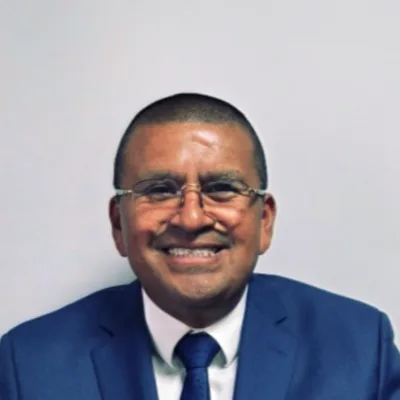
Jorge ContrerasPMP®
Twenty years in the Navy, from aviation maintenance officer aboard the USS Independence to the Civil Engineer Corps, with a Seabee tour on a construction battalion and a stretch as a public works officer supporting the Marines. Retired in 2015 with no transition plan at all, then fell into managing Air Force construction projects in Qatar, Kuwait and Djibouti because a hiring manager spotted that he spoke MILCON. Has moved between defense contracting, civil service and industry ever since, and earned the PMP® about a decade after he left the service.
Show highlights
- He joined as an aviation maintenance officer and served aboard the USS Independence out of Yokosuka, then moved to the Civil Engineer Corps because his background was engineering.
- Officers only count as Seabees during a construction battalion tour, and you only do that tour once. Going back as an operations officer, he says, is insanity.
- He was running S-curves and standup meetings for two decades before anybody handed him the label.
- Naval aviation had a manual everyone said was written in blood, because every line in it came from somebody doing the job the wrong way first.
- He retired on November 1st and didn't start looking for work until January, because he'd assumed retirement was the end of the story.
- His wife put a ten-page resume on Indeed. The call came from a man in Houston who recognized that he spoke MILCON.
- He was managing construction projects in Qatar, Kuwait and Djibouti before anyone told him the work had a name.
- One billion-dollar federal health record program ran textbook PMI and the delivery was predictable. Other employers called themselves project managers and had no process at all.
- A veteran thrives in structure and stalls in chaos, and the reason is the first question a military person asks, which is who they report to.
- He took the PMP® for the credibility and says it gave him the tools and the confidence. Whether it made him more competitive, he'll happily tell you he doesn't know.
Jorge Contreras joined the Navy as an aviation maintenance officer and spent his first years aboard the USS Independence, home-ported in Yokosuka. When the ship was decommissioned he moved to a helicopter squadron, and from there back toward the engineering degree he'd started with, into the Civil Engineer Corps. That's the community that builds for both the Navy and the Marine Corps, so the rest of his career was facilities work and contracting: a construction battalion tour that made him a Seabee for exactly two years, a public works assignment overseeing an 11,000-acre site, contingency projects overseas. He was managing money, schedules, people and risk the entire time. What he wasn't doing was calling it project management, and neither was anyone else.
The recognition came later and it came in pieces. He talks about running S-curves and standup meetings and realizing years afterward that both were in a textbook. In naval aviation there was a manual everyone said had been written in blood, because every procedure in it existed because somebody had already done the job the wrong way, and it turned him into a lifelong believer in writing the lessons down. The moment it actually landed was a civilian one. Working on a federal electronic health record program, he heard a colleague refer to a document as an artifact, asked why on earth they were calling it that, and then understood he'd been producing them for twenty years.
He doesn't dress up the part in between. He retired on November 1st, 2015, assumed he was finished, and spent a couple of months discovering he wasn't. The TAP class he attended he describes as a joke. He had no plan, no target job and a ten-page resume, and the thing that rescued him was his wife putting it on Indeed, where a man in Houston read it and recognized somebody who could speak military construction. Within weeks he was running projects in Qatar, Kuwait and Djibouti, a job he took before anybody explained that it had a title. The PMP® came about a decade after he left, taken for credibility and, he says, for the tools and the confidence to do the job properly. Ask whether it made him more competitive and he'll tell you straight that he doesn't know. What he does know is the order he'd do it in next time, and it's the opposite of his own: start a year out, while the military is still paying, and walk out with the certification already in hand.
Transcript
AI-assisted transcript, lightly edited. May contain errors.
Hey, everyone. Welcome back to another episode of Veterans in Project Management.
Stuart Bell here, joined as always by Dr. Michael Shick.
Hey, Stuart. How-
Mike, how's it going, buddy?
Good. Nice seeing you. I'm excited to introduce, an individual that I've, worked with in the past. Certainly a great individual. Did 20 years in the United States Navy, retired out, if my math is right, in 2015.
is that accurate, Jorge?
That, that's correct, Michael. Yes, so that's when I retired.
Well, that's fantastic. So tell us a little bit about what you did in the, the Navy. You were a, a civil engineering, corps individual, weren't you?
Yes. So my career, I s- it was, when I joined the Navy, I joined as what they call an aviation maintenance officer. So I had the honor to serve on a carrier. I was on the USS Independence, and that was, we were home-ported over there, Yokosuka, Japan. I was there for, two and a half years.
We decommissioned the, Independence, and there I went to a helicopter squadron where I was,a, material control officer and assistant maintenance officer. And then it was there that I decided that I wanted to transition back into engineering, my background in engineering. So I joined the, the Civil Engineer Corps, and then I did the, the remainder of my, 15 or 16 years with the Navy as a civil engineer corps, which gave me the opportunity.
The Civil Engineer Corps, they're, what they are is they're the construction agents, for the Marine Corps and the Navy. So we had the opportunity to do a lot of facility work, construction,and, a lot of contracting. So it was a very good career, very exciting, allowed me to serve with you as well in AFRICOM.
So it's, very diverse.
Yeah. So, so, please forgive my ignorance. as I'm an Air Force guy, so some of the, career navigation aspects in other branches is a little bit outside my wheelhouse. So you started off as a aircraft maintenance officer and then went into the, the Civil Engineering Corps.
Was that, is that kind of like the Seabees or-
Right.
Yeah, that's- Or did you have functionality or a- ability to go between Seabees supporting the Marine Corps and back and forth? H- how does that kind of play out?
Yeah, so, so the, the only time, so the only time that we are considered Seabees as officers is when we go to the, what they call a construction battalion.
So I had the opportunity to serve for two years on the construction battalion, and during that time I was considered a Seabee during those two years. You only do that tour once. if you're crazy enough, you can come back as an operations officer or a commanding officer, which, is insanity. But I only had the opportunity to do that for two years, and then from there I go back into my normal role, which is whether it's a, a construction manager, project manager, managing, large construction projects, large facilities projects,So, I, I got the op- As soon as I retired, as soon as I completed with the Seabees, I ended up serving with the Marines as an engineer. I got an opportunity to be a, a public works officer overseeing facilities and,construction projects. So again, being part of the Civil Engineer Corps in the Navy is very diverse.
It gives us the ability to do construction, a lot like, like, like with the Air Force does now. You guys, like the Seabees is, I think it's RED HORSE. Yes. I think it's RED HORSE and the other one. I forgot what the other one is. Red Horse and you guys got another one. I, I- But that's what the Seabees are ...
I think that one's, Prime BEEF, RED HORSE and
Prime BEEF.
Prime BEEF. Yes.
In party. Right. There you go.
Yeah. Fantastic. So, you did a, a couple of tho- spent some time with the,Construction Battalion and with the Marine Corps. h- it sounds like there was a, a lot of project management already in your, kinda in your career pipeline. Is that accurate?
That is about right. Yeah, that's correct. Yes. when you're,when you're in, in, even in, when we're in the city, you're doing a lot of contingency projects is what we do. Well, overseas contingency projects. But you have to manage the project, right? You have to manage the money, the time, the resources.
So you start with that, and then that, and as you continue to get promoted and go up the, the ladder, you are managing large projects. managing the budget, managing the time, making sure they're on schedule. then you're managing personnel as well. So it's, yeah, it's project management to, to the fullest and definitely, when you're building these projects.
Would you say that's in part based on your civil engineering? and I know your, you got your undergrad in mechanical engineering, but would you say this is kind of, part of your degree in kind of the pathway, or is it explicitly towards civil engineering and public works and, facility, management, those type of things, that you got that project management flavor, so to speak?
Yes. Th- That's correct. I mean, being in these positions, you're put- being put into these positions where you have to manage projects, you have to understand, the, schedule. we have to understand costs, all these indicators, y- your risk registers and so forth.
That's all part of managing a project, and you wanna-
Fantastic ... funny, isn't it? Some of the other guys that we've spoken to, it's been almost how you were doing project management, you might not have realized it when you were in, but a lot of those skills are transferable, and relabeling them or, reclassifying them as project management helps you kind of transition out into civilian life.
But on the civil engineering and the construction side, it almost seems like project management is built in. Like, it doesn't seem like it's the type of thing that you would have to tell the civil engineering branch that, "Hey, you're doing project management." It seems so, kind of, directly correlating, whereas some other branches it's a little bit more of a,a, a realization that's what it was afterwards.
Going into it, kind of from college and school days, was that the anticipation going in? Like, you really go into that industry as a whole expecting a chunk of it to be more on the coordination side rather than the, I don't wanna say doing the job, 'cause obviously it's all doing the job. But the coordination piece is such a big piece.
Was that true right from the start, or did you go into it and then there was a realization that, ah, yeah, there is a lot of project management related in this?
Yeah. I think it was the realization. like they're saying, sometimes, you don't, you're doing stuff, like, like you're doing S-curves and you don't realize, hey, that's, it's a project management tool,
or you're doing standup meetings, right? some, and you're realizing, hey, this is project management.
Or you're doing your daily meetings, you're doing all this stuff that you don't realize it is project management. All of a sudden it clicks and it's like, wait a second, I've been doing project management all these years. Yeah. And it hits you, Yeah. It- Then when you actually study it for then it becomes a reality.
Oh, I've done this. Like, that's strange.
Yeah. I can fully understand. It's almost like, it becomes intuitive before it's formalized- Yeah ... to a certain respect. So, when you went to the s- civil engineering corps from aviation maintenance, w- was aviation maintenance set up, in a similar nature where it was more formalized project management?
or did you kinda come to that realization after you had been do- with the civil engineering corps looking back and saying, "Oh my gosh, I, I also did some of this, or all of it, in aviation management, we just didn't call it that"?
As you well know, part of the,p- part of the, the stuff there about project manager is it's how do you deal with people?
How do you deal with your subordinates, right? And as, when I was in aviation maintenance, I was a division officer. So I was division officer for support equipment, I was a division officer for power plants. I managed, 25, 50 folks. basically took care of their day-to-day, requirements and their evaluations and so forth.
so you're doing that part of project management, which is taking care of people, right? that's another, that's one of those, those relationships that we forget about project managers. How do you take care o- of conflicts with individuals? How do you take care of conflict? taking care of folks.
Yeah, and to your point is, yeah, I didn't realize it, but yes, when you're a division officer, you're like a company commander in the Air Force, right? You're taking care of people, and you're taking care of their, their-
Yeah ...
whatever it is, family issues, time, So yeah. Well, again, started off on day one.
So as you're progressing through and, moving through your career, what are some of the things that you really, that you saw, that, that was highly useful, whether it be a framework that the Navy, taught you in training or, something that you picked up just based on best practices? How do you...
Kind of walk us through your career with the, the various different things that you did that were project-oriented,and some of those lessons learned that you picked up along the way, as you progressed.
You mean in, so where was I picking up during my transition- Yeah ... during my career goals?
Yeah, so thinking about it from aircraft maintenance and then moving into the various different roles, I know you, you have deployments in there, and contingency projects as you stated. Whether you were home station, afloat or, some sort of ground deployment, what are some of the projects and useful project management tools and techniques that you came across, some of the lessons learned that you garnered or maybe some best practices that you came up with just based on knowledge and experience?
Is there anything that stands out, in one or all of these various different roles you've been a part of?
it's interesting. you just said it. It's, one of the things that we were really big in aviation maintenance is, and when we started in aviation was we used to have a book called the 4798.
And it's the manual of what you do to, to regulations that we always used to say that book was written in blood because a lot of the, the lessons learned that you have, the, the best came from doing stuff the incorrect way, And in my entire career, I've always been a big proponent of lessons learned.
And I always said, what made me successful and why did I fail these positions? And you always jot those lessons learned and you pass it along, pay it forward to the next guy. You always set up your belief for success. That was always the motto, setting up your belief for success. and capturing,like project management we're taught to, have artifacts, have some documentation, whether it's what we, others call standard operating procedures, we call it artifacts.
Some sort of manual, some sort of guided service page. When we run into this problem, this is what you do. This is the steps to award. And if we, again, jot down those lessons learned and pass those along, then we continue to become smarter and smarter. As you well know, every, every new opportunity, every position that you take, there's always something that you need to learn.
Like, oh, I learned from this, I learned from that. So that was the biggest thing, I think, the documents of, mistakes to, not to repeat them again. I think it was one of the biggest that, that I would think that I would take it from.
Yeah. So lesson-
Do you find that one is difficult? Oh, sorry, Mike.
No,
go ahead. This is Nest. Do you find that one was difficult to instill in other people? Like you, I'm a huge fan of lessons learned, like for, if for no one else, then just for myself. Like, as I've got older, I think my memory's got worse, so if I can look back on some documentation that I did last time to try and not step in the same hole twice.
But it's always been the one that's difficult to get people on board with. I don't know whether it's the enthusiasm or the excitement of a new project and, ah, just wanna keep moving forward and not check back in. But were there any, tricks or tips or enforcements or punishments that you had to, get people on the same page?
not really. I think that it, one of the things I found out is that when people, they w- they wanna be part of the lesson learned or they wanna, embrace that, those are the kind of people you don't wanna be around, you know? Because those are the kind of- ... people that are like people that don't really care, and I hate to use that term.
Right. But the people who are on board who wanted to make the process better or the organization better, they were willing to do that. And I think the reason that a lot of folks don't like doing lessons learned, so, well, artifacts, for example, is because it require a lot of work. Which as you well know, there's gotta be certain formats, there's gotta be, how do you put this together.
creating the document that's going to teach others to do it is the hardest thing to do. How do you format it? And then once you have the format, then the, the rest is easy
to
share
the knowledge. Well, actually that point that it's a filtering criteria, that maybe it's a warning sign that maybe some of these, the people who aren't on board are maybe the ones who you wanna wa- watch out for.
I should've, I should've realized that sooner.
It's
true.
And I think to your point, Jorge, is people don't necessarily wanna do it, one, because of the work, but also what's the tangible outcome? when we look at a project closeout, right? And so we're looking at it simply from a PMI process group perspective.
the, the project's done, essentially. it's likely been delivered or in an agile framework, now you're doing a retrospective- I- I've already delivered what I've, intended to deliver. What is it... I'm gonna put all this effort to something that may or may not be used at a later time.
Now, I'd argue that's 100% the wrong way to look at it, but, on the same token, because it's such a pivotal aspect, one, to cre- take those lessons learned, drive them at home so they become a part of you. And, hindsight's always 20/20, and when you're going through it, you may not... An individual may not have the full scope of understanding of why something turned out the way it did.
And so by everybody coming together and thinking through it, and being able to build it out, it creates a much, more granular understanding of what the issue actually was, and so that way it doesn't come up again. and so- lessons learned and retrospectives are highly important. it's just trying to keep people motivated.
When everything's done, they may be looking for other jobs or, moving on to the next thing that they have to deliver that they're getting downward pressure from senior leadership or the project sponsor. but it's okay to take a tactical pause and focus in on the lessons learned for the short term.
is that kind of what you've seen as well, or am I just out in left field?
No, I mean, like I said, I think that it- it's, closeout is the hardest thing to do. And it, I, and trust me, when I used to be a, a construction manager in Puerto Rico, we used to call them old dogs. If, they, people f- like, to your point, they finish the project, they just move on to the next, and they never formally close it out, and it just sat there for years.
like, is anybody gonna close this, this project out? they're not doing the evaluation, da, da. So
to me-
So contract is
still open
to anybody. Right, exactly. they repaid the contract, And, to me, there was a, there was no bigger joy than closing out a project because to me it was like, "I'm done."
"This is it. I- I put the bow on it." But to your point, I think that if you're in the business, whether you're in the business of aircraft, you're in the business of, logistics, you're in the business of whatever, you're gonna continue to do the same projects over and over. You're gonna continue to do...
For example, and as you well know, sir, we deploy, once a year or whatever. What was those mistakes that you made when you were getting ready for deployment? Chances are you're gonna do it again in a year, so don't repeat the same mistakes. So i- whether a company is in, in selling rubber ducks, selling, building massive buildings, it behooves you to do those lesson learned because just, there's a 99% chance that you're going to encounter that project again.
So get smart the first time. And I think the other thing is, if you're doing the lessons learned, you're teaching the younger, the younger folks who are not as experienced become more experienced and avoid those hurdles, So I think it, it's, again, it's one of those things, to me it's always been a pleasure to tr- to, to train others to become better, mentor them to become better.
Yeah. Well, what would you say, is your favorite aspect about project closeout?
The, the best part of project closeout is to see the customer happy. to see that they recei- received the product that they asked for. Because that means that you were able to translate their requirements or their imaginations into paper, into reality, and see them happy with the deliverable.
that is the, the best feeling in the world.
So, so let me ask you, Jorge, when from your perspective, when all's said and done, you deliver your widget, whatever that may be, a- and for those who are not familiar with the term a widget, that's some generic thing that you end up delivering, whether it be a product or service.
when you deliver, you s- you get sign-off because you're within specifications and everybody's happy that, and it's all coming to close. You do your lessons learned. Do you- Is that the time to start giving out the medals or awards, have a, a get-together and a project closeout ceremony?
Or do you guys, once you deliver it, finalize the paperwork, and then everybody's on to the next project? how do you go about doing it?
military was,we don't do so many cer- ceremonies- ... but we did get together. We did get together, like whether, we're squad leaders, folks, that we'd get together in a conference room and give kudos, to the folks who did the work.
Especially if you're in a management position, it's a leadership position, it's very important to recognize the folks that did well and give them those kudos because it pays dividends. when you start appreciating the people, when you start, understanding that they worked, whether it's overtime or weekends and so forth, you have to give those, those acknowledgments, because then it's gonna motivate them to say, "Hey, I want to do more.
the..." Great, but it's also gonna inspire them in the future one day when they are leaders as well to say, "Hey, my own boss used to do this. Maybe I should do that as well." So it's part of teaching.
Yes. Well, and,you're... It's not outside the realm of possible that you're gonna work with these individuals again on another project.
Plus, i- if somebody's working hard, then they should be recognized for, the initiative that they took, so that's fantastic. Of course. do you... So how- You did 20 years Did you move right into project management after your time on active duty? Or how did you... what happened as you were transitioning out and moving into the civilian corporate type structure and environment?
So that transition was where I think I... I think a lot of us veterans struggle in that transition. I struggled significantly when I left the military, 'cause I thought I was retired and I was not. They're like, "Okay, I at least get a real job." And I didn't. I know there's a lot of other veterans who have plans, but I didn't have a plan, hours to transition to the workforce.
So I failed in that aspect. and it took me... To be honest with you, it took me a few months to get away to, to understand that I had left the military. Because the military, what I miss the most about the military was the friendships, the closeness of the units, that you have.
And when you lost that, I didn't have that. I had my family, which I was blessed with that, but I didn't have the com- camaraderie that we had in the military. And I didn't have a plan. And, I think it was around... So I retired November 1st, I was officially retired. And then it was around, I would say, no- January that I said, "Hey, maybe it's time for me to start doing something else."
like getting a job or something. 'Cause I started to get bored and I said, "Okay, I need to go- get out there." And then so, my wife helped me a lot. She put a lot of applications out. She was like... 'Cause I, again, that's the thing about military, we don't know anything about Monster or, LinkedIn.
We don't know any of these, these terminologies. where do I put my resume? and she... I remember she put my resume out on Indeed. I think it was Monster. And, out of nowhere I got a call from an Air Force, gentleman, who worked for the construction, what was it? Contingency Facility Management Group, out of Houston, Texas.
He was like, "Hey, how would you like to work for the Air Force and manage some projects overseas?" And I said, "Sure." So I kind of bumped into a job by mistake, is pretty much what happened. But I didn't have a plan. what I always tell somebody is, have a plan. Have, have a... Sit down with a resume writer, s- say whatever.
what is the ideal job that you want? And, target towards that, that goal. And then start, applying resumes and whatnot.
Did you not go through TAPS or anything like that?
I did, but TAP was, I hate to say it was a joke. It was not very... It w- the TAP that I went to was not very well put together.
it was not... all I remember is they said, "Write out your resume, put it on here." it was not, what I thought it was. so I think that-
I guess that's the risk. That's the risk, isn't it? Like, with a big organization dealing with however many 100,000 people a year going through the system, it can be, same as anything, a little bit hit-and-miss.
And if you're- don't have a plan and you're not particularly Focused on anything that you want, and you're just gonna get carried along by the system. If that system kind of is a little bit lacking either at the time that you go through or a little bit more systemically, then you really can find yourself...
That clock ticks away anyway. You're gonna find yourself out and, I don't wanna say on the street, but on the other side- Yeah ... with a bag in one hand and a resume in the other and looking around for what next. It's, yeah, it can be a little bit hit and miss unless you're kind of driving it a little bit more yourself.
and I think to your point is, that we have to invest in ourselves. And I think that, whether you set aside some... That should be the plan going into retirement is saying, "I'm gonna set aside, X, Y, and Z amount of dollars to, get myself prepared, get a, get my... whether it's a, an, resume service or a service that will prepare you to take interviews."
You need to do some sort of investment in yourself as you're going into that transition. And so to just to your point, the tap is just the check in the box. It's like, yeah, he went through that class. He's good to retire. we'll move on. But yeah, you definitely need to, as a veteran, you need to put the money, put time i- invest in yourself because it's gonna be very different.
So- I think
time as well as money i- is there's opportunities that kind of expire on the clock with everything else. So those additional trainings that you might get access to or just some programs, again, they're things that expire. You've got access- ... before the date, but after it disappears.
Sorry, Mike, I talked over you there.
No. absolutely not. don't... No worries. So- I'm trying to think through, all right? So you retired November, 1st, 2020, or I'm sorry, 2015. Right. And then you did not start submitting resumes or responding to posts. Maybe it was your wife who started responding to posts in January of 2016.
Is that relatively- Right ... accurate on the timeframe?
that's accurate, right.
So you- how did you wind up, like, other than the work that you did up to this point, which sounds like it's, was quite vast, was there any preparation that you did to get into project management? Were you even focused on project management, or just mainly looking at your, fit reps over the years and saying, "Well, this is what I ne- I know how to do, so, that falls in within this wheelhouse, so that's where the, the resumes are gonna be pumped to"?
Pretty much. Pre- pretty much that, that was it, I managed X, Y, and Z projects. I managed this, this amount. I was a public works officer. I managed a 11,000 acre facility. I built this, I did this, and now I manage these funds. I, I, and that's put it all into a page. I mean, my first resume I think was like 10 pages.
It was ridiculous. And I think that some poor guy called on and said, "Hey, this guy knows how to speak military. He knows how to f- speak, MILCON, which is military construction." So they just grabbed me and says, "Hey, how would you like to do this job?" And next thing I was managing projects overseas in Qatar, Kuwait, and Djibouti.
But I didn't realize that was project management. "Hey, wait a second, you're a project man?" I did not know that. And-
So even when you're retired now after doing that for all the years, and now you're... Were you a civilian or were you a contractor?
I was a, I was, so my first job was, I was a contractor for the Air Force, yes.
Okay. and so what are you doing now?
So now,I work for a construction company,a small American contractor. So I work for them and we're managing projects, overseas. no, not overseas. management projects in... There's a small part we're managing in Kansas. So that's what I'm doing right now.
So how did you go from contractor? Did you have anything between y- being a defense contractor into what you're doing now, or did you go from this contract role into something else before you are where you are now?
Yeah, in the last two years I've jumped around a lot.
I went from being a project manager, and then I went back as a GS-4 to work as a facilities director where I was managing a, a team of 50 bargained individuals. We're overseeing all the, facilities for the Navy base. and then I had to leave that job. I got another job working for another contractor.
We're doing a lot of the, electronic health record management program, which is connecting the Department of Defense with the Veterans Administration so they can talk to each other. Right now the computer system's on top. And then from there I got a, a chance to work for the, Department of Treasury, as a officer for next release student, as a, operations specialist.
So and then finally, due to the government drawdown, had to leave that job and now I am, where I'm at right now is a project manager with civil construction.
My goodness.
For civil department. So
you've drunk, jumped from contractor to civil service- Yes ... to, industry, back and forth- Yes ... quite a bit.
Yeah.
e- so this is a question that I think is particularly relevant, is all right, you've seen it from the military, and maybe not necessarily knew it was project management per se, you, although it was formal. Now especially looking back, and between contractor, civil service, industry- Outside of, environmental factors and organizational process assets and things of tho- that nature, their own little policies and nuances, is project management essentially done the same way, across the various different sectors?
No. No,it's not. I'll give you an example. when I worked for the, electronic health record management program, that office took project management pretty much from PMI. they were structured, they had artifacts, they had, some, they had some standup meetings. they had risk registers.
they were project management to a T, 'cause they wanted to document everything and, the only thing they didn't call it is they didn't call it sprints or ACT or, they didn't use those terminology, but it was pretty, pretty strict, pretty project management,intense.
And I liked it because it was very structured, and it made things very easy. because you knew that in order to get from A to B, A to C, whatever, you had to follow these steps, And it's like, okay. There's other places that I've worked too that there is no project management. They say project management, but it's all over the place.
there's no standard structure. They don't do daily meetings, they don't do artifacts, they don't do risk registers, and it's, it's chaotic. And when you have something like that's chaotic, it's not well organized. So, that's when I realized that, like I said, all these terminologies, I'm like, "Oh my God, this is just project management."
I didn't know it. I remember the first time using artifacts, I said, "Why are you calling it an artifact?" that's weird. and but that's, project management 101, right? that's the terminologies. and it hit me. I'm like, "Oh, God." So that's where I, that's where I realized, okay, if I'm doing this, I need to get the certification to be part of a team, to-
Yeah
play with the big boys, That's why I think it's so, so important, but I didn't know it. Like I said, I've been doing it all this time, but it didn't dawn on me, like, oh my God, this is, you're a project manager.
Man, that's fantastic. So yeah, and
PMI- It's interesting
that- Go ahead, Stuart.
Sorry. It's, we're having a tiny satellite delay today. We're kind of talking over each other a little more than usual. or need more coffee. It's, one of the two. it's interesting, the different, there is an assumption, I think, that on the one hand that coming out, maybe you see the civilian world as, As a thing that's not necessarily immediately translatable.
But when you look at all of the government contracts there are across the board, the fact that you've got language and frameworks and disciplines and experience that is very translatable makes that journey a lot easier. As you say, with no particular plan, out of the blue, someone with a very close, requirement set to yours called you rather than you having to call them.
And then the other thing is just the breadth of it, the breadth of all of those government organizations. The fact that you have security clearance, that you have a shared language, that you know the touch points on the other side of the project. It really does open the door to people thinking...
I think that they might come up out thinking this is scary and it's different, and it's just all civilian, in, in air quotes, whatever that means. But actually, that bridge, there's a vast swathe of the kind of gray middle between completely military and completely civilian. The people you worked with in those contract days, are, were they...
Was it a good mix from a similar background, people who had come in through the pure civilian route and people who had transitioned in from a military route?
the first, when I worked with the Air Force, they were all retired. They were all veterans. So that, that made it pretty- Right ... pretty nice.
And it was very helpful because the ma- the products that we managed were for the f- the Air Force Farm to the Defense. So understanding the, that language helped a lot. And the other places that I worked, it's been a mix. It's been a mix. It was more c- more civilian folks, some, a sprinkle of, retired military.
so it's always a, it's always a, a, a sprinkle of military and the civilians.
Yeah.
It- I was thinking along that lines, Stuart and Jorge, was- Seeing the range of formality of project management inputs, tools, techniques, outputs, things of that nature, you're looking at... you can make an argument for tailoring based on the organizational need, but you, what I think you also touched upon is the importance of that structure to make it more effective.
The question is does the output, did the output demonstrate the formality and the actual,li- more linear traditional waterfall approach to delivery? Did that have better efficacy in the output? Or, on the flip side, on the, in the projects that were more chaotic, were, were the teams able to still deliver at the same level of expectations, customer client expectations, it was just more messy in between?
Yeah, it was, I think that, for example, the, with the company they use the, the, the pure project management. I mean, if you look at EH- the electronic health record management program, it's a billion-dollar program, and there's a lot of designs, there's a lot of moving parts, and the delivery was pretty, pretty nice.
Pretty streamlined, pretty, pretty predictable. it was great output. It was not, it was chaos, but it was managing all these hundreds and hundreds of products. the delivery was seamless. The other places, you can tell that it's, the delivery is poor because they don't have a standard process.
they call themselves project managers, but they don't know what project management is. They don't know how to do the simple stuff. It was,
you
know.
Fair enough. E- For, for those who are coming out of the military, whether they separate or retire, what have you Do you th- why would somebody, with a military background thrive in one or both scenarios, in your estimation?
If they're with an organization that's not formalized project management, but they just say, "Hey, you're a project manager," versus one with more formal structured processes.
So the, the military individual will feel better with the structured one because we know in military you have a, a chain of command, you have a leader.
You have a structured hierarchy and so forth. That military person would not succeed well in a very chaotic environment because their first question is going to be is like, "Well, who is the... Who do I report
to?" Start with the basics at least.
Yes, and so that military individual's gonna be s- struggling in that chaot- chaos.
But in structure, we thrive in structure because that's what we lived our entire careers.
Yeah. Yeah. Well, you don't think a, a military member can say, "Hey, I'm just gonna beat this, this square peg through that round hole. I'll just keep grinding at it and, with grit and- A lot ... to force it through?"
Depends. I mean, that's the
grind.
It depends what position he's, he or she is hold- hold. Right? If she, he or she is in the position of that they can, enact change, by all means, they can formalize it. But if they're just at the bottom of the barrel, they can't, they can't change if you're all the way at the bottom.
You're just one of the other individuals who are just part of the, the chaos if,
And even then, I mean, that's two very different jobs. Like, if you're going in to set up structure, that's one thing, but if you're going in hoping to encourage structure, man, you gotta be committed to that not to want to jump- Yeah, and the-
out the window at some point. It's,
it- And back to our earlier conversation is people will not take to change likely. They will fight change. They would rather stay in the chaos if it requires work to change that chaos.
Yeah. And feasibility as well. I mean, it's easy. I've had the same experience coming from larger, more structured organizations to smaller, more organic, small businesses.
Even the commonality of language, like trying to explain to someone the concept of a risk register or even an accountability matrix or even meeting notes, I mean, to various degrees, trying to educate people and bring them along, unless that's the mandate, it's challenging. And, yeah, you gotta know what you're letting yourself in for if you wanna be the one- Yeah
to go in there and change.
it's hard. Change is hard. I mean, it's scary. Yeah. You're,
Yeah ...
it's costly. And then y- th- and in the process when you're trying to make all this change, you're not gonna make a lot of friends. That's the other thing.
Right.
Yeah. it,
so- Or deliver on what you were employed to deliver in the first place.
Like, if you're going in there thinking, "Oh, I'm gonna... They want me to do this, but I'm gonna go in there and change that," again, it's, it can be an uphill- Uphill struggle
Oh, 100%. Especially if key performance indicators aren't necessarily identified and, it's not well organized, so yeah, talk about herding- Yeah
cats on that front. So when did you say, "All right, I'm starting to see this, the formality of this all"? when did you look at earning your project management professional certification? What made you decide that was the one that you wanted to go after? And,has it been useful for you?
It, I felt that if I was gonna continue to be, like, a, a project manager, which is pretty much what I'm gonna focus and do, then I need to have the tools to succeed, and the credibility as well. Because as you all know, having the P- PMI certification gives you a little bit of a boost, when you're on applications then.
but then I have, I found that it has changed me. It's given me the tool and the confidence to do the job better. now has it made me more competitive? I don't know. I don't know. that's a great question.
Yeah. W- When did you earn it, Jorge? I earned it,
I earned it last July is when I- Oh, okay.
Test ... so I
got it last year. just got it. Yeah.
Yeah. what'd you think of the, the studying and the test?
It's, from a person who is not, as an engineer, I'm not used to reading a lot, or, because all we do is we deal with numbers and c- calculations and computations, and then we ‑‑ we ‑‑ et cetera.
But reading a lot of this complex language, we're like, "Oh my lord." It was very difficult. So difficult, and what was cool is that the job that I had previously, with the, veterans with the electronic health record, had taught me some of this terminology. So I was like, "Ah, now I understand what they were doing with this."
Yeah. Now I understand what they're reading.
So-
So-
Yeah. Ch- check this out. Stuart, I don't think that I've told you this. So, Project Management Institute, with their exams, they have a few different,the questions that they're testing out to see if they want to roll them into the overall question bank, and there's a certain number of them that are these,pre-published type of questions.
I'm pretty sure when I sat for the exam, it was my very first question was one of those. So I get in, I'm on minute one of the exam, and my f- very first question, I read it, and it did not make sense. Like, the words did not actually formulate a complete sentence or paragraph. I read it, and then I read all the answers.
I was like, "That doesn't make sense. I have no idea what it's asking." I read it again. Same conclusion. I read it a third time. I was like, "Oh my gosh, this has to be one of those, because it makes zero sense." But I'll tell you, right out of the gate, to get that question-
Oh, man ... "
Okay, let's move on to number two."
Of... On a four-hour test and you're, a minute in, and you're like, "I don't even know what this just asked me."
I did a, not wanting to derail the conversation too much, but I did a realtor, like, for some other business that we did.
It was useful to have a realtor certificate down in Florida, a real estate license down in Florida. So as I was... I'm not a realtor at all. We work with a lot of them, but I'm not a realtor. So, and there's only just been recently in the US as well, so coming from the UK housing system, which is quite different.
So anyway, going through the training, someone had said- I don't know how true this is, but someone said if you select Spanish as the language when you start, the questions are worded in a slightly more straightforward way. The questions are actually in English. When you get to the next page it's English, but they're worded in a slightly more straightforward way.
So I don't know whether this is true or hearsay or not. So I go into the class, I can... I struggle with English. I can speak a little bit of Welsh from where I grew up in the UK. Spanish, there's no- there wasn't much Spanish in the '80s in the UK, so no Spanish. So I, "Okay, I'm gonna do it." I tick the box.
The very next screen after ticking the box on preferred language was in Spanish. I'd been told that the questions were in English, so I get to the next stage and the language there doesn't make any sense literally, to, to me with zero skills. And I suddenly thought, "Oh my God, I made a terrible mistake."
So fortunately then it flicked back to English so it was okay. But I can imagine that experience. You do all of this studying, you get in there, you can't even pretend the language excuse, and then, it goes off on a tangent. So- Oh ... yeah, I feel the pain for pushing through and rivalling anyone.
so Jorge, I know we're coming up on time.
What... I- if you had a recommendation now going through 20 years in the military as a... Then going in and being a contractor and a civil servant and working in industry. I mean, you've kind of hit all the gambit. You don't have a not-for-profit in there as well, do you? All right. So-
Getting the full card.
Yeah. what... Let... Think of that, that sailor,that, that senior NCO or that, that officer. What... And I understand that each one of them are gonna be coming out with a little bit different skill set and lens by which they're going into the job market. But overall, let's say y- you were advising somebody to go into project management.
What would you say to them as they separate or retire from the military?
When you separate, the first thing in, I would say, is a, a year out before leaving the m- the service, start preparing for that transition. and again, the military is just great because the military pays for a lot of your schooling.
So if you wanna pursue project manager in your year out, have the military pay for your schooling, pay for your PMP, certification, and start working so that, a year out, And then start targeting the job that you really want to when, once you're getting ready to leave, There's no- there's nothing that says you can't take an interview while you're six months out, from the military. On the contrary, it's gonna prepare you better, when you get ready to leave the service. So preparation, I think, and like we had talked earlier, preparation and definitely investing in yourself.
You have to take, take some time to invest in yourself, to prepare for that transition out and,get as much education as you can. In this case, get your PMP a year out and focus on that,
Yeah. Do you see any value of, a certification or some sort of training while they're still in, even if before they even decide to separate or retire?
Of course, yeah. Yes. Yeah. Any certification that you can get is... I'll give you an example. in construction industry, they,they'll always ask you, do you have your, EM 385? EM 385 is the Army Corps of Engineers Safety Manual. It's a course. It's a 40-hour course. You could take that on, when you're in the military.
You can go online, take the course, get it out of the way. there's also a quality construction manager course that is free to all servicemen, and you can take it online. Again, all that alphabet, as we call alphabet soup, get all that alphabet soup out of the way. get all those, that education as much as you can.
Go through all your training records and say, "Yeah, I have-- have I taken what all the, the training we've taken the entire military career?" Put that together in some sort of binder and say, "Here it is." Because you will know we have access to all of that, our training record while we're still active. Once you leave, you don't.
So get all that training. it's valuable. Definitely, to prepare you for what's the outside world. Because once you leave, then you have options. Now you can say, "What can I do? I can do this, I can do that." there's just so many opportunities to be diverse with the rest of the world.
Yeah. That's fantastic advice. Thank you so much. Any, parting words for you, Jorge?
No, I would say thank you so much for the time. This has been a, an amazing conversation. I really enjoyed it. Thank you so much both of you for taking the opportunity and for, to give me the opportunity to share my thoughts.
So thank you.
Yeah, no, I appreciate it. Stuart, over to you. Do you have anything?
same as always. I mean, I think the real difference this is making is to people listening who just have their eyes opened, not 'cause this is complicated or hard, it's just different. And Jorge couldn't have said it better.
Like you've got so much time leading up to it, get it out of the way beforehand because as soon as you, as soon as that line in the sand is drawn, as soon as you cross that threshold, access to stuff goes away, time gets compressed, pressure to do other things all builds up. So just get it out of the way sooner rather than later.
And, and the world really does, there's more opportunity, at least for the world to open up in front. So Jorge, thanks again for sharing these, sharing your insights.
Yes, 100%.
Thank
you. your wisdom that you were able to impart and I think listening to you, Jorge, was, is one of those things that, that came through to me is, a lo- you could have the same career field, whether it be MOS, rating, AFSC, what have you, but individual experiences are going to be different for everyone.
there's gonna be overlap, but just the variation in experiences a- and hearing about those can help shape the direction that we take going forward. And these lessons learned, that's what essentially this is. This is a little bit of a lessons learned. And so being able to take those lessons learned from people who have done it before you is important as we progress from whether we're mid-career or we're looking to separate, retire, or if we're already in industry and we're trying to pivot into a project management career.
So ultimately,just food for thought as we move forward. Thank you so much, Stuart. Thank you, Jorge. Fantastic thoughts. Thank you, my friend. great catching up with you, my brother, and,Take care ... wish you all the best.
Thank you, my friend. Take care. It's been a pleasure to reconnect with you again, my friend.
Yes. Thank you so much.