Airborne Infantryman to Program Manager
Disclaimer: The views expressed by the hosts and guests on this show are their own. They don't represent any branch of service, employer, or organization they're affiliated with.
Listen
Chapters
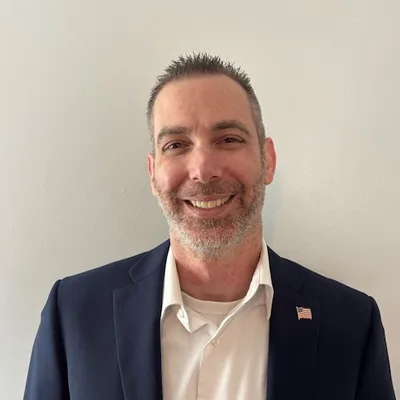
Trevor GreenbergPMP®
Served seven years in the Army, from 2004 to 2011, as an airborne infantryman and jumpmaster with the 82nd Airborne Division and in operations at the Airborne School at Fort Benning, leaving as a staff sergeant. Earned an MBA from Auburn on active duty and later a second master's in organization development and change. Has worked in project and program management for more than 15 years across commercial and government work, and holds the PMP®, the PMI-ACP® and a Lean Six Sigma black belt. Hosts The Disgruntled PM podcast and writes a weekly PM Monday series explaining one project management term at a time.
Show highlights
- He came into the Army in 2004 with a bachelor's degree, which made him a specialist straight out of basic and put him in charge of privates who knew far more than he did.
- Training to be a Black Hat at the Airborne School, he blew out his shoulder in the 34-foot tower.
- He started an executive MBA at Auburn on active duty, back when the Post-9/11 GI Bill covered tuition and fees with no cap, and graduated on terminal leave.
- His first job out of the military paid about eight dollars an hour at Auburn's student athlete library.
- A retired first sergeant running a retail store told him civilians don't run by military standards, and that he'd be the one adjusting.
- On his first day as a PM he told a stressed finance colleague that nothing in his world couldn't wait 24 hours, and for the rest of his contract, colleagues came to him to get things from her.
- His biggest pet peeve is the claim that military service makes anyone a natural project manager.
- Running a drone program, he asked not to be told about a confidential safety review so he could keep dealing straight with the vendor.
- He says hybrid project management without governance is buffalo wings and Sour Patch Kids in the same chili.
- In his first governance job he audited PMs with ten years on him, and asked each of them to convince him why they didn't need an artifact.
- He failed the PMP® three times before he passed, and he compares it to a jumpmaster qualification: a shared language, not proof you can do the job.
- Mike's 2023 look at Indeed found about 24,000 postings asking for the PMP®.
Trevor Greenberg joined the Army in 2004 with a bachelor's degree already in hand, which made him a specialist straight out of basic training and sent him to the 82nd Airborne Division in charge of privates who'd been through far more than he had. He served as an airborne infantryman and became a jumpmaster, and then reenlisted for a three-year tour at the Airborne School at Fort Benning. He meant to be a Black Hat instructor there. His shoulder went out for the second time in the 34-foot tower, so he went to operations instead. A year in, he decided to get out at seven years rather than go across the street to OCS. He told his first sergeant so, and he got the job nobody wanted: running the Airborne School's mail room, which would have ended the career of anyone who planned to stay. It gave him the time to start an executive MBA at Auburn on the Post-9/11 GI Bill, back when it paid full tuition and fees with no cap, and he graduated on terminal leave.
He got out in 2011 as an E6 and a combat veteran with an MBA, expecting six-figure offers. His first job was about eight dollars an hour at Auburn's student athlete library, hired because the man who ran it wanted veterans because they weren't intimidated by the athletes. He moved up to IT support and then to running e-commerce for a small college clothing retailer, where the store manager downstairs, a retired first sergeant, told him civilians don't run by military standards and he'd have to be the one who adjusted. Trevor calls that his aha moment. He worked in Lean Six Sigma before he ever held a PM title, and one of his first project jobs was governance, auditing the projects of PMs who each had about ten years on him and a PMP® he didn't. He went on to run a program that brought the first Israeli-made indoor drone to the US market, and to government contracting for the Army and work for the VA. He failed the PMP® three times before he passed it on the fourth, and he's open about that and about the eight-dollar job.
His argument with Stuart and Mike is that the military doesn't make anyone a project manager. It can give you parts of the job, but in uniform your authority is on your chest, and on a project there's no rank to lean on. He thinks hybrid delivery without governance lets every PM invent a process only they understand, and that well-designed governance should take friction out of the work rather than add it. On credentials he lands in the middle: the PMP® teaches the fundamentals by standard and gives everyone in the room a common language, the way a jumpmaster qualification does, but it isn't proof you can do the work. His advice to anyone thinking about the switch is to find out what the job actually looks like first, by asking a PM where you already work if you can shadow them. He hosts The Disgruntled PM podcast and writes a weekly PM Monday series that explains one project management term for the people in the room who aren't PMs.
Transcript
AI-assisted transcript, lightly edited. May contain errors.
Hey, everyone, welcome back to another episode of Veterans in Project Management. It's Stuart Bell here, joined as always by Mike Shick. Mike, how's it going, buddy?
Good, Stuart. Thank you I'm particularly excited for this next, guest. Trevor Greenberg is, a podcaster and has been in project management for a little over 15 years now.
And, before that, he spent some time in the military and, he came to us by way of, Russ Parker, who had said, "Hey, you really have to talk to this guy. he's been in the space for quite some time." And, so we're excited to have Trevor on the call with us today. And so Trevor, what'd you do in the military and how'd you find your way into project management?
Well, first off, I think you're overselling me there.
Well, may- maybe not. I'll just blame Russ. How about
that? All right. Hey, that works. We alwa- I can always blame Russ.
For sure.
So I did seven years in the military from '04 to '11. I was in the Army. I was, I'll say a marginally at best airborne infantryman in the 82nd, and then I did some time there, and then I worked over at the Airborne School, not as a black hat because I blew out my shoulder the second time while I was in training, so I went over to Ops.
got it. Yeah. That's, th- so you blew out your shoulder. was that during training, or was it just something, you know, that happened outside of training?
I had hurt it during basic training, and then while I was in training for the, to be a Black Hat, I was sitting in the 34-foot tower throwing students out, prep- practicing throwing students out, and then all of a sudden shoulder just goes out on me in the middle of throwing students out.
Oh. Look over at my instruc- at my cadre that's treat- that's helping me. I'm like, "I just blew out my shoulder." He's like, "All right, what do you want me to do about it? Get your... Go to, go down the tower and go to the medic." Yeah, it's like,
standing on one leg- That
cadre doesn't seem to
think ... is fun. But I mean, it was just one of those, like, what do I do here?
I'm in the 34-foot tower throwing out students and I just blew out my shoulder.
I'll tell you, a few years ago I had an issue with my shoulder and I, i- it's not as awesome of a story as throwing people off a tower. I-
Well, let's- ... think it's because I slept on it ... let's pause there and, let's pause there and clarify.
'Cause when I say I'm throwing students out of the tower, they're harnessed up, they're going through the mock tower. It's actually safe. I'm not literally throwing them out of the tower.
no, I got you.
That's the, that's the language difference, right?
Yeah.
Either people know what you mean by thrown out of the tower, or people hear that and think, "Oh, that seems a little bit, Exactly.
yeah. Mine, my, my shoulder incident was more on, I slept on it funny, and then subsequently got to deal with it for the next couple of years. So it was far less amazing. But I'll tell you, the, h- it's astounding on how painful a shoulder injury is. Like, for the life of me I couldn't even put my hand behind my back.
That, that's how painful it was. So, I w- I wish I had a much cooler story than I, I do. But, anyway, so you went over, to the ops side. Yep. how long were you there for? and, you know, is that how you found your way into, you know, the early works of project management?
No. I was over in ops.
I was on a three-year assignment that I reenlisted for while I was overseas with the 82nd. And year one I kind of had to reali- I had to make the decision 'cause I'm, I'll be up on seven years at the end of my contract. It's like, okay, well, I've already got a bachelor's degree. I'm at Benning, which means I'm across the street from OCS.
So I can go to OCS if I want to, but if I do that, then that's career time. If I serve my seven and get out, what am I doing when I get out? And so I made the decision early on in my tour at Benning to get out, and I actually started my MBA program at Auburn while I was in, while I was on active duty.
And I joke that I'm the reason they changed the post 9/11 GI Bill. Because this is back in '09, right after the, or '08, right after the GI Bill, the post 9/11 GI Bill came out.
And I switched over from the Montgomery one, 'cause that's what you do, right?
Yeah.
People got the same great ideas, right?
I applied... Yeah, so I applied to go to Auburn for MB- for an executive MBA program, and they asked me how I was paying for it. I was like, "Well, I've got the GI Bill, so why don't I just use that?" And I talked with the people in the education office and they said, "We had just gotten back from an all-day presentation on the post 9/11 GI Bill."
And they asked me, "Do you know how many slides there were about active duty?" I'm like, "I don't know." One slide, five minutes.
Right.
And I got it, and I was there when it covered 100% of tuition and fees with no cap.
Wow. Wow. I mean, being in the right place at the right time is always handy.
So I got my... I actually graduated with my MBA while I was on terminal leave.
Fantastic. How did that all stack up? Like, the work commitment of getting through an
MBA program is pretty significant. How did, like, the organization of doing that, do you feel like it was, like you really had to commit and go all out, or did it kind of work itself out so that you could manage it without pulling all your hair out?
Well, this is where the militar- Talking to fellow vets, you'll understand this.
In ops at any TRADOC school, if you're not an instructor, you're basically dead-ending your career there. For the most part. Like, unless you're an, unless your job is ops, like I was infantry. If you're at the Airborne School and you're in ops, most people looked at you like you did something wrong because you're not a Black Hat.
Right.
So I wound up telling my first sergeant, having a conversation with him early on, that, "Hey, I'm getting out. I have no intentions of staying in. You're not gonna convince me otherwise. I'm working on my master's." And he's like, "All right, you're going over to ops." And then while I was there, the person that ran the mail room for the entire Airborne School was PCSing, and he's like, "All right, you're going over there because I don't need to worry about your NCOER after this, 'cause you're not staying in, so it doesn't matter."
So I got a really easy job running the mail room for the Airborne School. It was, there was a lot that went into it, but it was very easy, so it gave me a lot of flexibility to get schoolwork done and do things like that while I was on active duty. And I did the favor by taking that, that bullet, so to speak, of the career-ending role that nobody wanted.
Right. It's funny, isn't it, how things align. Because, like you said, just as it works perfectly for you because you got another plan- Yep ... it also works perfectly for them 'cause it's a, you're solving a problem for them that everyone's a winner.
Yeah, 'cause you got an E6 that doesn't, that you got an E6, and if I had stayed in, whenever I PCS out, if you get NCOERs that say, "I was in the mail room at the Airborne School," your next unit, you're not getting a squad.
You're lucky if you're getting a team.
yeah. It's a suggestion on, it's not a suggestion on capability, it's just, It's what have you- ... what were you at the time ...
what have you done for me lately?
Yeah. Yeah. and, Yeah, I, th- there's so many different ways that you could go, about that. But yeah, you certainly did a solid for the unit, and it positioned you well for your transition out.
So what'd you do when you got out? So you were on terminal leave. You finished up your MBA. You're down in, Columbus.
Yep.
and did you stay in Columbus, or did you ... I ... What, what happened from there?
I stayed in Columbus for a little bit, but I was also dating my now wife at the time, and she lived in Auburn running one of the off-campus bookstores down in Auburn for the university.
So eventually it was, I moved in with her. I joke that I got out, I got out and I was, my head was full of it, I'll be honest. Like, I thought, "E6, MBA, combat vet, everybody wants to hire me for six figures no problem." Yeah.
Yes. '
Cause back in 2011, everyone said that, right?
Oh, 100... Well, they were saying that, you know, up into the late t- 2020s, or, teens I should say.
Yeah.
yeah.
And I had a, some opportunities that came to me, some that I probably, looking back in hindsight, I probably wasn't ready for 'cause I botched them royally with the interview. Some I chose to just not wanna take, or subconsciously sabotaged them probably because they weren't roles that I was interested in and that I wanted to do.
But when you're out of work on terminal leave, you take every interview you can get.
Yeah. Yeah. Did you have a feel for what the type of work was before you transitioned by going in for the MBA? Was that a very specific path that you had in mind for the next step, or was it kind of MBA's an option and a step today, and then worry about what that turns into later?
Well, it was, I looked at it as I've got two years, or two and a half, maybe three years when I was, when I realized that I was gonna be in ops and I wasn't gonna stay in. So I thought about it, I'm like, "How do I set up my exit strategy the best way I can in advance?" Because I already had my bachelor's, so- I didn't need to worry about that. And I know this may sound kind of cocky or some, full of myself in some ways, but when you look at the facts, that's what I'm looking at, is I had my bachelor's, I didn't wanna stay in, so what do I do next? So- ... I go to grad school. And I looked around and I found the Auburn program.
It was 45 minutes away from Benning. They didn't require a GMAT. I actually was not qualified according to their requirements, because you had to have 10 years of professional experience for this program. But then when I sat down with them during the interview, I explained to them, "I have led soldiers in combat," you know?
"I've jumped out of airplanes. I'm a jump master," you know? Right. And, but I'm, a civilian, I translated the language to be more real. But I explained to them, I'm like, "Look, I haven't been in corporate America for 10 years. I've been busy leading soldiers in combat. I've been busy making those tough decisions in life and death situations."
And, you know, we say all that now in tongue in cheek, but back then people believed it, that it was like, okay, you know, you've cut your teeth and then some.
Yeah.
So-
But even to that tongue in cheek point, I mean, there is some... Everyone can, we can all roll our eyes a little bit 'cause you see it kind of- overused in some places. But that translation from the language there to the language that they needed in that academic environment, taking that little bit of extra work to make that translation, make it real and obvious for people, there's a risk of people now overly dismissing it and not wanting to mention it at all, or really playing it down and thinking that it's overused.
But I think there's definitely the opportunity for people to make those connections for the people on the other side of the table who don't know. But putting yourself in the best light for that opportunity, and doing that translation job for them.
Well, there's also one other part that was very, I don't think anyone will admit this, but it was probably very instrumental in me getting in, was I walked in with the GI Bill So they knew they were getting paid.
Right.
And we, you know, higher education is its own conversation of a whole, but when you walk in to a master's program telling them you're already fully funded, you're not taking out loans- Yeah ... you might not be able to make it all the way through without paying, you know, all those different variables, you're whacking out a major concern they have of, for their graduation rate, for their, all of their metrics.
Yeah. If they know it's funded, they're gonna let you in. Like, that's the sad part of it is. That's the truth.
Yeah.
Well, and just to go back to the, the tongue in cheek side, I would say, certainly it's overused and it can be overplayed, especially within, communities with similar backgrounds.
It's just "All right, yeah, guy, I've heard that a million other times." But it's also something that is real and tangible. Now, the quality of decision making, in stressful situations- ... and the ability to lead, that's a different discussion. But having to be able to make a s- decisions, i- in those situations, I'll tell you since I've, been out, and, and it, the first time it was really poignant, 'cause I'm in academia, was saying, "Hey, y- you know what?
You can go home for the day. you can take a minute to actually think through. Nobody's gonna die." I was like, "You know what? That's true. I can." and, so I would say, I get it 100%, and it's so easy to get lost in everything else, y- you know, within corporate environment. But, the, your experiences, certainly, you know, they add a different dynamic to an environment that most people, especially outside of government or military work, have no concept of.
And so, that, that does count for, some, some considerable points depending on the area that you're in.
Well, we'll jump forward a little bit here, 'cause it's, what you're bringing up is a story that I like to share a lot, is I was working for a healthcare company. My first day, my, I was a PM there, and my boss tells me, "Hey, I need you to go up to finance, find this person, and tell them we need this expedited."
So first day in the office, obviously I go to the wrong floor three times. I spend 10 minutes looking for this person's desk, asking 10 d- asking 10 different people, "Where is this person's desk?" I finally get to the right person and I say, "Hey, I'm Trevor. So and so told me that we need... asked me to come up here to get this from you and said we need to put a priority on it."
And I see this person is already stressed out, and she was just, she's like, "Oh, you know, I don't know. You know, I might be able to get to it today. I'll see what I can do this afternoon." And I just looked at her and I said, "There is nothing in my world that can't wait 24 hours. Might ta- might cost a little bit more, might take a little bit more time, whatever.
Whatever the downfall, downstream effects are, everything we do can wait 24 hours."
Yeah.
And she just kinda looked at me and was like, "You're my savior." And I said... And what's funny is I worked for that company for about a year on contract, and fast-forward a little bit, people were coming to me to go to this person for finance for different things because I had earned that relationship right from the beginning of not saying, "I need this now," and, "You have no idea who I am."
Yeah, right. Exactly.
Yeah.
and I think that's one of the things that we learn in the military more than anywhere else is- There's a sense of urgency, and we talk about it, and we talk about, oh, you know, going back to the cliches, seconds count. I was there when, you know, all those different phrases. But the reality is that in the corporate world, there are very few things that can't wait 24 hours to get settled out.
There might be downstream effects, there might be cleanup, there might be whatever it may be.
But very few ro- very few things are life and death, and we forget that because we pr- we, we manufacture the urgency of what we th- what people think is urgent. And then when you look back and you're like, "That's not urgent.
That's not even... That barely blips on my radar of important."
100%.
Yeah.
100%.
the psychological management or the people management skills as well, that separation we've talked on a few shows before between, like, the importance of the task and the importance of the people, and knowing that particularly in the civilian world, it's quite a strong blend of the two.
But knowing not to go in there on the first day and start trying to shout around to get things done because it's, that's not gonna lead to a successful outcome. Definitely not in the long term, maybe not in the short term. It's, yeah, it's quite a, a mindset sh- set shift to get into.
Yeah. So back to my transition.
So I got out, graduated with my MBA. I'm on terminal leave, did some interviews. Nothing panned out, and my first job out of the military, accomplished E6 with an MBA, was working at the Auburn Student Athlete Library for about eight bucks an hour telling athletes to shut up. Part-time.
Not complaining.
That was my first job out of the military, and what's funny is I got that because the guy that ran the Student Vets Association knew that the guy that ran the Student Athlete Library wanted vets for that role because we weren't intimidated by the athletes.
Right
And this was back in 2011, after, right after the Auburn football team won the national championship, when Cam Newton was finishing up. All the... Half the team went to the NFL, so all those guys were hanging out waiting for their time to wrap up so they could go to the NFL.
And I just remember, you know, one of...
There were so many moments there where I was like, "Okay," you know, "Whatever." And I just showed up, did my job, wound up getting promoted to IT support. And one of the basketball players I always say we think back in moments of snapshots or shorts of things.
And I remember a basketball player coming in, and he's like, "Yo, told me I need to come in here.
I need to get a laptop. Hook me up." And I looked at him and I said... I was doing something on my computer. I looked over at him at, in the doorway, and I said, "You can exit the door, you can exit my office, turn around, and come back in and treat me with the same respect you treat the person at Chick-fil-A, or you can turn around and not come back."
And he tried to stare me down, and I just looked at him, and I was like, "This ain't happening." And he turned around, he came in, was very polite, very professional, and I said, "Happy to help you."
Those environments where the bravado or the kind of, whatever the right word is. The entitlement ... that kind of, the, right, yeah.
yeah. And the lack of, not really seeing people, just seeing, "I've got to do a thing," and a robot's- Well, it- ... on the other side handing me the thing. It's-
And to him it was a task that he was trying to do the task, and not acknowledging that there were people that he had to, that had to help him.
And what's funny is I went back to the person that was working with him, who was a staff member, and I said something to her, and she was like, "Yeah, you was kind of surprised you did that." And I was like... I always say, treat me like the person you treat at Chick-fil-A. That's all the amount of respect I want out of people, because it's impossible to get mad at the people at Chick-fil-A, and it's impossible to go there and yell at somebody because they're just doing their job the best they can.
Yeah. Yeah.
So- That- So you were in IT. You're in IT, and, working the, essentially service desk or a help desk type of function?
IT is being very generous.
Okay. Did you stay there, or did you end up going from- ... from there into,other IT, like project management- I- ... roles or, or-
From there I went to, it's a small specialty retailer that sold overpriced name brand college clothes to college students.
They had, like, nine stores across the southeast, and I got a job there working for their, running their e-commerce division.
Got it.
And what's funny is, I didn't realize it at the time, but probably the person that was most influential in my transition out of the military was there, and I didn't even know it until probably I had one of those aha moments.
Because-
Right ...
the company was not a vet company, it was just a bunch of people that worked in corporate, in the corporate world.
And our corporate headquarters were on top of our flagship store in Auburn. And one of the things you do when you go work for a company, especially in retail, is you go walk the floor and talk to people in the store.
Yeah.
And our store, the store manager was a retired first sergeant, and he found out that I was former, that I was prior military, so he was like, "Hey, you need anything, let me know." And there was a point, like ev- like we all have, where after a few months you're just like, "Does nobody understand how to do follow-through?
Does nobody understand how to get things done? Does nobody understand that when you say you'll have it on time, you'll have it on time?" You know, all those basic things that we thought of in the military as that's just, that's background noise before we even get to the real work. And I went to him one, and I went to him one day, and I was like- "What's going on here?
What am I missing?" He's like, "You're not missing anything. They don't run by our standards." And that was my aha moment of I've got to adjust my thinking, not the other way around of everybody else working the way I'm used to.
That crossover between kind of like fundamental project management skills of just structure and understanding that there's bits that connect together and the connective bits are where the friction is, and then coming from a military background and having that structure kind of, it's a fundamental again.
Those two, that's why I think there's such a big career f- in project management for people who come from that background, because the two worlds marry up so nicely. And everyone, not everyone else, a number of people else out in the world just don't even see it. It's like a foreign language. So that if you're wired that way, you're wired that way, and if you're not.
All right, I'm gonna disagree with you here on some of the things you just said.
Oh, nice.
Because one of my biggest pet peeves is, "Oh, you were in the military, you're cut out for project management."
Yeah.
Because-
Yeah,
I know what you mean ... not everybody in the military is meant to be a project manager, because there's the law of averages that there's- The super soldiers, and we've all had those leaders that were the epitome of what you would think of as a leader.
And then we've had the people that you wouldn't trust telling them to take out the trash. Right. And everywhere in between. And I don't, I know there's a lot of talk and certain influencers of everybody's a PM, and there's a lot of motivation behind that I don't wanna get into for politic, political reasons.
But I just think that not everybody is meant to be a project manager, and just because you were in the military does not mean that you're predisposed to project management. It means that you may be predisposed to aspects of project management. But we all know who have done the job, there is a significant blend of, what do I have to know out of the book?
What do I have to know about the real world? And how do I ma- how do I make those two balance in a way that makes me successful at what I'm doing?
Yeah.
I think, you know, listening to you, Trevor, I think one of the key aspects, that you brought up is, predisposed. And y- what I think you're saying on that is because the military, generally speaking, and probably more than just generally speaking, but it works in the finite.
So while it's, you know, writ large, it's an enterprise and it- it's got operations that are supposed to go into perpetuity. But everything is broken down into, bite-size bits that, that brings the enterprise as a whole. And so individuals who are in the military are used to operating in the vi- environment, but, as you so properly said, you're gonna have a big delta on the tails if we look at a normal distribution.
Yep.
You know? It, you're gonna have some, some, individuals that there's plenty of opportunity for improvement, and then there's those rock stars that, that are able to get out there and get it. And so being predisposed and have a, a fundament- or a basic understanding of project management, that's, definitely doesn't translate into them being successful project managers.
Is that fair?
Well, I'll take that one step further and expla- and say that- If you spent... I actually had this conversation with someone who was not in the military, and they said, "Oh, you must have loved it in the military because, you know, you were in charge and that made it easy to translate over to the civilian side."
And I was like, "No, it's the exact opposite." Because in the military, you wear your authority on your chest or collar, period. Like, there is no discussion of if you're a staff sergeant and you're in front of... Or if you're an E6 and you're in front of a group of E4s, there is no question, no debate, no discussion of who's in charge.
Period. End of story. The E6 could be the worst human being alive, but they're in charge.
Yeah.
In project management, there is no rank. There is no visual display of who's in charge. So your job is not to lead through... You know, we say it all the time, it's not leading through authority, it's leading through influence.
So as a, if you're coming from the military mindset of rank is absolute, rank means I'm in charge, rank means that I follow this person. Like, I remember doing interviews where I would sat there and said, "Oh yeah, if they're my boss, they're my boss. They're in charge, you know, this and that." And then later on I was told, "That's not the answer I was looking for."
and it's that understanding that just because you've got a CEO in the room, as a PM, your- it's your obligation to tell them their idea is dumb if it's dumb and it's gonna derail your project, and explain why
Yeah. Well, and, all right, so I take your point, and I think that may... If we look at it from an enterprise as a whole type of perspective across all different branches o- of service, and just within the Army itself with the different branches based on MOSs- right? you're gonna have a different way in which leadership is conducted and management is conducted because, you know, it... Just to go back to the basic definitions of leadership, that's that transformational experience and you empower people. And management is all right, now you've got the, you will do step A, B, C, D, et cetera.
Well- and then measure it. I would say, you know, depending on the branch of service, you know, there, a- and MOSs, you may have guideposts. And certainly when rank is involved i- in more conventional forces, you're going to have that, hey, to your example, the E-6 is always going to be in charge of the 4.
Then you take into other, say like Special Forces, where the specialty takes primacy. And I understand that's smaller, far smaller groupings of folks that are leveraging that. But to bring it back to the project management side, I think ultimately the point that you're making does make a lot of sense, unless it's a projectized organization that it- everybody's filtered t- through.
But even then, that doesn't make for a, a strong leader that in fact could be a terrible project leader and, that's simply focused on bringing value that,while crushing the team, and that, that's not effective either. And certainly from a, a military perspective transitioning into it, having that mindset is not going to position somebody well to, transition into a project management type of role.
One of the exercises I like to do often is devil's advocate.
So let's take, for example, what is project management? you're leading through influence to complete the project essentially. I don't know if that's the textbook definition, but that's the truth of it. Now, you take that into the military structure, I'm now leading through influence.
Rank doesn't matter. Okay? You're gonna have a stellar E-4 outshining that mediocre E-6, and then guess what's gonna happen. Let's say we put that E-4, like we've all seen it, the E-4 team leader pres- for example, and then there's an E-5 somewhere else who's like, "Man, I need a team," but they won't give it to him
Now there's resentment, now there's all those other side effects going on because you're rating someone based off of skill even though someone else has more rank.
Like, I was a college E4. I came in with a ma- with a bachelor's degree, so I was an E4 right off the bat out of basic training, and I went to the 82nd as an E4, and there were PFCs and E2s that knew way more than me, were work... Went through workups and everything, but technically I was in charge.
Yeah.
Now, let's...
Do you really think they ever said, "Specialist Greenberg, you're in charge of these privates that spent six months doing ITC and you just got here?"
Remind me of, That's like a- ... a lieutenant and their senior NCOs.
or I was a corporal because I went to jump master school as an E4. Corporal is the worst rank you can humanly have in the military because you're considered an NCO so you get all the NCO assignments, but you're never really in charge.
and these are the kinds of things I talk, I think about because it's like we talk about all the stuff on the outside, and they forget, they whitewash all the important stuff that makes the military structure run. 'Cause the military structure is what makes the military run. It's knowing who to report to.
It's knowing that rank is absolute. Rank is in charge, you know? you walk around and you go from one base to another and you show your ID to somebody and say, "You're mess- you're wrong here, and I'm gonna show you my idea to s- to do an on-the-spot correction." That correction is made on the spot because you've got the rank and authority to make it even if you're in civilian clothes and they're in uniform.
But you go on the outside, I see Steve from accounting doing something dumb at the bar knowing that he's making our company look bad. I'm not going to Steve and saying, "Hey, you're embarrassing our company at the social outing." I'm letting Steve act a fool because that's not my problem.
That level of organizational structure and accountability versus responsibility, I think the benefit that the background has where all of that structure is established by the rules and the precedent of hundreds of years- Exactly
of making it work, it gives something of a framework that oils the wheels. But at the individual, like in the macro level, at the micro level it can still get friction, and you run into people who just are pig-headed or bad at the job or not pulling in the same direction. But at the macro level at least, the organizational level, that structure is there for mission success.
Whereas in the civilian world, it's not quite in the same way. The, the micro human dynamics kind of take over and to a bigger or lesser degree take over more or less. But that transition in the military background person doesn't make a good project management, but the structure that they've lived within gives a framework for what could be a successful project- Exactly
in the civilian world. Exactly. But if you ignore the nuance at the micro level, at the individual level of working with Steve who's always drinking, or Mary who doesn't wanna do the job because of something else, some other resentment, that's where it's not, it's not guaranteeing success just because of this, but it gives a framework that can be brought in.
But I do think the friction is then the framework that can be brought in is being brought into a organization potentially that has got no concept of what that framework could be. I always remember I worked for Goldman's. We were outsourced IT- ... but worked within the Goldman structure as one of the earliest jobs, and as a benchmark to set expectations of how a successful organization works, that was fantastic.
But the 20-year headache going off on after that is trying to explain to people what good could look like in an organization where it just physically can't look like 'cause it's not a billion-dollar company.
Well, that's a leadership topic all to itself that I like to use because I always say we don't realize when you have it good until you get it bad.
Because I've learned more about leadership from the terrible leaders I had than from the great ones, because you take it for granted- Right ... when it's easy. You're like, "Oh, this is the way it's supposed to be," and you don't pay attention usually to what's going on because it's naturally so easy to take care of.
But then when you get that terrible leader and they- They decide that what they wanna do is the way it's gonna go. That person that got promoted early, that person that was, did, that got promoted based off of s- things they did in the past, not because of their skills, their skillset and ad- their skillset in what the job is, but not taught how to be a leader and not made sure that they're actually leading effectively, you learn a lot from that 'cause you're t- 'cause I always say, I said, "I'm never gonna make somebody feel this way. I'm never gonna do this X, Y, Z," because I remember how miserable and how much I hated it and how much I resented that person. So let- But then you go back to that good leader and you're like, "Oh, now I'm paying attention because I appreciate- yeah
what's going on."
So let me ask you this, Trevor, is when, let's go back to that, that marginal, E6 with the rockstar E4. When you're in, project managers have to develop the relationship, generally speaking. A- again, it depends on the organizational structure- ... whether it's projectized or a matrix organization, what have you.
And you're gonna have your functional managers that, that are responsible for those functional areas, and the project manager has to rally everybody around to, to get their work done. When you have, say, let's just say hypothetically speaking, you have that, that staff sergeant in the Army context, that's in charge.
Let's call him the project manager, and then you've got the E4 that's the assistant project manager for whatever the scenario is. Isn't it the responsibility of that, E4 to s- navigate that relationship just the same as they would with any of the functional managers to get the job done?
I don't think so.
Really? Why is that?
Because they are not the ones, you know, we like to throw around responsible and accountable in the project management world 'cause it's half of the RACI.
Yeah.
But if you define what responsible and accountable mean, is that assistant project manager either one of, an R or an A anywhere on that RACI?
Broadly speaking maybe not ... broadly speaking
Probably not. yeah
Broadly speaking, they are informed and consulted at best because they're the assistant. They are not the one in charge.
Yeah.
So if you're not the one that's in charge, you can advise and consult, but it is not your responsibility to be providing somebody else information to make them look good.
Like, if I'm the, if I'm the junior resource to a team, and the senior resource that's responsible for everything doesn't know their head from their rear end- ... I'm gonna be... I'm gonna try to help them get through it, but by the third time I'm told, "Go away, you don't know," I'm gonna go away and say, "Okay, I don't know," and let them fall on their face, and use that as an opportunity to be a spotlight ranger, and pick up the baton and get that promotion.
And that sounds evil and sadistic, but if you can't help somebody, why do you wanna keep helping them to stifle your own career when you're not allowed to shine for what you know and what you can do?
All right, well
then- Those individual... Sorry.
No, no worry. Please.
I was just gonna say, those individual dynamics, which I don't know if it's less in service than out of service because it aggregates down a little bit.
Like, you can't have- ... that much edge cases that you can get away with in civilian life h- here, 'cause the machinery just grinds to a halt a little bit- Yeah ... more obviously than it does. But those dynamics in the civilian world, it's almost like the job is the job, but to what degree do we have to be psychologists and deal with, like, the human nonsense that would just be so much nice if that all went away?
But the reality is, it doesn't go away. You've gotta live within that. And to the extent that you know the trajectory that you want your career to go, that you know where the edges of success in the project does, you know what you've tried to do and get burned before. And like you say, you can only raise your hand so many times and get it slapped down before you start raising your hand.
But the human element dynamic to it, again, talking about people transitioning out, it's... If that piece is underestimated, I think that can lead to a headache because you're just coming in with unrealistic expectations and, like you said before, you slowly start realizing that, okay, I need to m- change and manipulate to this environment, not expect the environment to m- manipulate to me, even if I would like the environment to be different.
Yeah. That, it... Well, I mean, and, it... Real quick, just to double up on, on that, Stuart-
and Trevor. I'm thinking about a couple of scenarios. So I think doubling down on this thread and kinda building it out. So, let's say for example, all right, now you're the, E4, and the E6 is the project sponsor.
All right? Yeah, now got it on the RACI matrix. a- and for those who aren't familiar, responsible, accountable, consulting, a- inform. It's how you communicate with others. and it also identifies who is, you know, in charge of specific areas. you know, you can get a project sponsor that is ultimately responsible for the execution or deletion of a project.
and yes, you as the project manager i- are going to have to, navigate that space, but you could conceivably go tell that person three times on what they should be paying attention to and told to pound sand just as if, an assistant project manager does to the project manager. So is there any real dynamic, difference other than a little bit of agency that the, the project manager has?
Well, in that example I would throw out that if I'm the PM and I'm butting heads with the sponsor, I'm rolling over and letting the sponsor tell me what they want, because they're the ones writing the check. But I'm documenting every single thing along the way to- ... cover my rear end to make sure that I made it clear this course of action is not gonna work for the project, but if you're the s- if my sponsor says, "You do this or I'm pulling funding," I look at them and I say, "Okay, what's more important to you, the project or the funding?"
Because one thing that's really starting to get me thinking a lot is the new structure of the project, the new modern project manager that we're creating, where they're talking about we have to be business experts, we have to know how the finance and the ROI works and all that.
Yeah.
And I look at it as we are delegating down more responsibility to the PM that should be held at the strategic level, because the sponsors and the stakeholders, they are responsible for strategy.
Project managers are responsible for execu- are responsible for s- for facilitating execution. We are not responsible for execution, correct? Everyone agree with that?
Yeah. Yeah.
So-
th- that interestingly, that, that's, that can be a whole second topic- Well, yeah ... in conversation- But- ... because, there, I understand where at least one not for profit organization is going with that.
But, the, for right- But when I'm- ... j- for the sake of the discussion, yes, let's do it.
Let's argu- for the argument of argument's sake, say the definition of a PM's role is to fac- which generally speaking, is to facilitate the project execution. Because PMs do not do the, are not by definition supposed to do the work, right?
Well, it depends on the project size,
but- Well-
Yeah ...
I mean, we can, it depends all day long. It depends. I'm speaking in general- yeah. I'm painting with very broad brushes based off- Yeah ... of loose, well, I won't even say loose, I'll say fairly strict interpretation of PMI standards.
Oh, it- Yeah
especially if you start going back to the early PMBOK, the project management- But- ... body of knowledge. Like, early on, yes. So- It was much more doctrine-oriented, if you will.
So when you start telling PMs, "We are responsible for facilitating the work to be done. Oh, and now I want you to know about the return on investment, the finances, and the ben- the net benefits and all those things," I look at that as that's an abdication of responsibility and role from the stakeholders and from the sponsor, because my job as a PM is to execute at the project level.
You move me up to a program manager, I'm now executing, or I'm now responsible for strategically managing multiple projects that tie together to create a strategic goal. And then on, so to portfolio and PMO, but one thing we always forget as PMs is we do not have all of the information. And when you look at the strategic level, the le- the stakeholders, the executives, there is so much going on about a project behind the scenes at the strategic level that we're not read into because we're not meant to.
And I've used this example many times. I was working on a interior drone project. I brought the first Israeli-made interior-only drone from Israel to the US. While I was working on this, there was, there were some safety concerns about the product for the US market. And my boss, who he happened to be a retired one-star, was awesome human, awesome person.
Not what I expected a general to be. But he comes to me and he says, "Hey Trevor, we're bringing in this outside tester for, for the safety pro- for safety protocol." I'm in a meeting with my boss, my VP, head of legal, and maybe three or four other VPs. And they said, "This is very important. This is internal only.
Here's how we... Any communication that's done via email has to have this specific markings, and if they don't, then it's subject to, if there's a lawsuit from the vendor, it's subject to, discovery and all this other stuff." And I got read into a whole bunch of legal stuff.
And I looked at my boss and I said, "I want no part of this," because I'm the main POC.
I'm the p- I'm the program manager that's responsible for dealing with the vendor on a daily basis. And I said, "I want no part of this. I want no knowledge of this. The less I know, the better." Because when I'm talking to our client or our vendor, whatever term you wanna use, the manufacturer of the product, knowing that this is going on in the background and I can't talk about it is going to taint how I discuss things with them.
And I do not wanna be the person that lets it slip that we're doing this behind their backs. Yeah. Whether we were legally allowed to or not, I wanted no part of it. And then fast-forward three or four months, they would bring it up periodically to me and I'd say,la. Hands and ears, I don't hear this."
And-
That
accurate- And it was by design.
Right. That's what I was just gonna say, by design. That accurate scoping of being read into different pieces, plausible deniability- Exactly ... information dissemination. So we started off the conversation just then where you were saying that more and more the feeling is that PMs are getting asked to do strategic roles.
Yep.
You guys are, both of you are much closer to it than I am these days. Do you find that is because people are unwilling to take responsibility for decisions, so they're trying to a problem shared is a problem halved, and they're trying to just make, drag other senior people into the role so that there's, "Well, I talked about it with three other people, so it's not completely my fault"?
Or is it kind of like an organizational push to reduce headcount and just consolidate, responsibilities within fewer people? Or what do you think is driving that-
I think that this is becoming a self-in- this could be a self-inflicted hemorrhage, hemorrhaging wound. I do agree that we do need to have knowledge of business sense and a knowledge of understanding of how our project impacts the greater scope.
I 1000% agree with that. But when you start telling me I'm responsible for showing you the ROI of y- of my project that you're in charge of, that's where I start to ask some questions, because I'm not read into all the decisions that go into everything else above and beyond my narrow window of oper- of operations.
So in my mind, everything could be going great. We could be perfectly crushing this thing to get the ROI that we... To get above ROI of what we promised on the charter. But then you add my project with three other projects in the program, and that ROI becomes a fraction of what we promised in totality, and nobody looks at it in the minutiae.
They look at it as the program is failing because three programs drug down one good one, or three projects drug- Yeah ... three bad projects drug down one good one. And then as the PM, I'm looking at the other three PMs going, "What the heck, man?"
Yeah. Yeah. I have a little bit different look,than Trevor particularly, on this.
And this is why I suggest that we have another discussion, because we could go deep into this. and from my perspective, there, it's a few-fold. as one being a professor in project management, what we do is we take, at Western Carolina, is we take experienced project managers and then smooth out and professionalize them to be able to move into C-suite type of roles.
And if you don't have that development and you don't have that understanding of how your project fits into the programs, and then those programs fit into portfolios and into the PMO, how are you going to be able to necessarily move in? Plus, this i- the ability to take a bottom-up approach to project management, not only from a facilitation perspective, but to push that information up to your leadership to build and f- paint that complete picture, y- you're selling the project short and you're selling the overall, when I say team, the organization project side of the house, short of what you're trying to achieve.
There's this ballet, so to speak, or this dance between operations and projects, because projects are typically those innovation, change management type of things that are supposed to drive... Well, one, if we look at it from a compliance perspective, keep people out of trouble. Two, we look at it, you know, as driving organizations forward and keeping them relevant to do, solid,S- keep them relevant within the market.
And so when you're looking at those type of options, it, to drive it forward, drive the organization forward, being able to get into some of the nuance and advise appropriately like, "Hey, yeah, got it. You guys want X, but really we need to s- start looking at, Y or we gotta kill it," is the respo- should be in part the responsibility of project managers.
And the last thing I'll say, and this is, goes kinda into the next scenario, that I wanted to throw in, Trevor, because we're not even gonna chat hybrid. but if we look
at- Oh, don't get me started on that.
but if we look at it straight adaptive or agile, all right? Now you're a scrum master, i.e.
a project manager- Yep ... that has a product owner, but now you really d- aren't in charge, but you are supposed to be that servant leader to support everybody. And, you know, you're not even ... In some organizations you're not even accountable for the project because that's the development team. And so, you know, when we take that E4 and E6 scenario, it, you know, in more of a traditional or predictive approach, and then try and trans- y- you know, lay, overlay it with an adaptive approach, how do you see that shift happening from your perspective?
I've actually written about this, that the hybrid approach to me is- In a way, one of the biggest cop-outs we've ever created as PMs. Because what it does is, and hear me out on this, I want thou- I will say, and I say this all the time, that certifications are great. The textbook is great because they teach the theory, and they have to teach the theory in a sterile environment.
It has to be done in a sterile environment where everything is ideal cir- circumstances. Yeah. But then you've got to know, how do I adapt the ideal theory into the real world, and where does that push/pull come of I'm gonna do something that the book didn't say but it makes sense for this application?
Now, we say that's adaptation, right? Now you take, I'm gonna create a hybrid environment of I'm gonna take the best of agile and I'm gonna take the best of waterfall.
Tailoring.
We- we'll get there.
Tailoring.
We'll get there.
Yeah.
So I'm gonna take the best parts of agile that I need for my pers- m- for my special idea, and then I'm gonna take the best parts of what predictive or waterfall that I need for my idea, and then I'm gonna mix them together and make my own special proc- my own special process that only I know what's going on in it, but it makes sense to me, but everybody else it should be crystal clear to.
And I equate that to w- I like h- I like buffalo wings and I like Sour Patch Kids. Would I put the two of them together in a s- in a st- in a chili and say it's good? Yeah. So, so the theory is that taking some of the best parts, the sum of the parts does not equal the whole. And I think that hybrid, in a way, because no, no governing body has taken a stand on here is a framework for how to run a hybrid project, we're giving license to PMs to do whatever they feel like is comfortable to them and call it hybrid.
And for some PMs, they are fantastic. They think in four-dimensional chess. their hybrid process is bar none fantastic.
Yeah.
But then you've got the delta to the other side of that bell-shaped curve, where you've got the person just picking and choosing things, nothing makes any sense, and then we wonder why the project failed, because it failed off of structure.
And I've got a Lean Six Sigma black belt. I just wrapped up a, my second master's in organization development and change. So I look at all of this as, I look at everything as process.
Yeah.
And if we're not defining the process in a scalable and repeatable way- You're designed to fail. And when we start allowing hybrid, because there's no structure behind it, it can be really good, or it can be that Buffalo Wing and Sour Patch Kids.
I gotta tell you- Yeah ... I love that analogy. And
anywhere in between.
it, it- And- I- Stuart, you and I spoke a little bit about this, 'cause w- b- Stuart and I, have been both, PRINCE2 practitioners.
And so projects in controlled environments, and for those who are watching or listening and are not familiar, that is essentially the, United Kingdom's approach to project management.
And it sets up an organizational structure and talks about the, a framework to managing projects. Where PMI is much more, well, at least it was, it's starting to loosen now, was much more process-oriented. Yeah. You had inputs, tools, and techniques and outputs. And then you throw in Lean Six Sigma, so to reduce,defects and, eliminate waste, and, you know, that's very much process-oriented.
and each one of those are projects and project managers are required. Then you start throwing in SAFe- Yeah, I was gonna say. SAFe ... and Agile, and everything else. it, you know, the challenge is because project management is all across industries, being able to come up with a universal approach to project management, I think we're a long ways off from it, but it's definitely something to be able to merge.
But yeah, that's the difficulty with hybrid, is how do you replicate successes, and how do you, how are you identifying the variables that make one project successful? And we talk lessons learned, but how are you going to move that over when the variables are similar or is, you know, vastly different to be able to manage, track data, and, you know, continue to be successful and increase the success rate in delivering value?
And it, that is a steep pyramid.
I can answer that in one word.
Yeah. What's that?
Governance.
Governance.
Because I work- my first act- one of my first actual PM jobs was working in governance. And here is Trevor knows nothing about project management formally. I was that, I was the person that I had done a lot of Six Sigma work prior to actually moving into project management, and here I am surrounded by PM's who had an average of 10 years of experience.
Everyone a PMP, everyone a CSM, and I'm, I don't even know what PMP stands for. And my primary job was auditing projects. So I would go into, I went into the first one, and I had my checklist, and I went through and I would ask the PM, "Okay, let me see this, let me see that." And I... It was the worst meeting I've ever been in.
It was literally the worst meeting, because I'm sitting there demanding all this checkl- I'm... It's exactly what you're envisioning. I'm demanding to see this form, this ch- this artifact- ... this artifact. And they're looking at me frustrated, because they didn't need it. They didn't see the value in it.
Yeah. So the next time around, I said, "Okay. I am going to tell..." I started off every audit with, "I don't know as much as you. So what I'm gonna tell you is, you need to be able to convince me why you don't need this artifact, that I could, in a way that me, the dumb person, can explain to somebody e- to my governance boss why we don't need this.
And if you can do that, if you can convince me why you don't need it, I'm signing it off as not necessary."
I... this is an aside, but the power of humility and the ability to acknowledge that and help people create that understanding, I think, this is an aside, but that is- Yeah ... a under-leveraged, leadership talent that...
or characteristic that, Well,
and- ...
helps significantly.
And do you know what happened with every audit after that? They became significantly easier, because the PMs, they would get frustrated that I didn't understand something, but it would teach... It did two things. One is it taught me a lot about learning about project management, but it also forced them to get out of their ivory tower of PMP language, concepts that only we understand as PMs that we talk about.
Like, I... Well, actually, I don't wanna say that one, because that's a idea for a show- ... that I don't wanna let out. but the idea is, that was the genesis for my PM Monday series. Every Monday, I break down a project management term, and the whole idea was it's not for the PMs. We all know these terms. It's for everybody else in the room that has no idea what they mean.
Like, when was the last time you heard a RICE Scoring System?
It's been a while.
I covered that this... I covered that, I think, last week or two weeks ago. And what it does is, number one, it makes me get sharper at my skills, 'cause I've gotta break it... 'Cause I've gotta revisit some of these things that I've taken for granted as I know them.
And then the other part is, it stops the bastardization of terms, because-
That's
the- ... we use these terms every day- Yeah ... and if you don't understand what they mean outside of, like, let's say MVP is minimum viable product, right?
Now, if you know nothing about what that means, you're gonna assume, "Oh, that's the smallest portion of the project that we need to be able to sell it."
And then you go and use that assumed... You use that inferred definition to somebody else, and then somebody else, and then somebody else, and we play the game of telephone, and by the time somebody, that third person comes back to the PM and says, "Oh, yeah, the MVP- the MVP's done." And you look at it and you s- that's nothing like what I need.
Well, isn't it this? And then we start realizing there was the conflict of language to begin with.
Yeah. So- I think that's the fundamental risk with the hybrid approach, is it gives... Whilst the move towards it is the buffalo wings and Sour Patch Kids, the move towards hybrid is saying, "Okay, well, actually someone else came up with buffalo wings and salt and vinegar chips."
Yeah.
Fantastic. It- to give people the flexibility to pull all the tools from the toolkit into something that works. But the problem, which I think we're all talking about, is that language, that communications, that governance gap in two people describing different ends of the elephants, everyone's happily using the same language, happily- Yeah
putting this program in, this structure in place that in their head is perfect, and why wouldn't it possibly work? But when it loses that commonality of language from a, kind of a baseline of the framework, you're then starting to introduce a lot of noise right from the start. Which- And let's,
let's take this example one step further, because I'm gonna throw out a scenario that we've n- none of us have ever seen this, of course.
But you built a hybrid s- you built your hybrid process and for one reason or another, someone else has to take over your project.
Right. Yeah.
You know? We've, we- Yeah ... none of us have ever had to take over an imperfect project. Couldn't possibly happen. Right?
Right.
but that's why I said that governance solves 95% of the problems that we complain about in the industry.
But I don't think that governance is used effectively, because unless you've worked in it, you don't understand its true purpose. Governance is not- Yeah ... there to be the fun police and to make you do more work and everything else. This is one of my principles, is process, it should be designed to reduce friction working with the human dynamics.
Meaning, if you have to get... H- okay. Do you... We have to get- Three layers of approval for a $50 purchase. Once again, no one's ever seen that, right?
Yeah.
How much money do we spend in 15 minutes of three leaders doing that approval for $50?
It's certainly over $50 per-
Exactly my point. But if y- so if you adjust the proceed- adjust the approval flow to, for $50, my frontline mana- my first line supervisor needs to be approval for 50 bucks.
But now let's say I need to buy a $5,000 server. Okay, that warrants three layers of approval because the friction is by design, designed to allow for proper judicious decision-making. But for $50, there shouldn't be judicious decision-making in that unless it's a repeated purchase that then we get into patterns and thinking about things-
yeah
long-term. But for a $50- Yeah ... for a $50 purchase, like my boss used to, when I was working on the drone project, my boss constant- told me, he's like, "Look, you have a corporate card. If you're on, if you're on site and you need something, I trust your judgment by explain it to me and I'll probably approve it."
But he said, "The, the moment you break my trust with that decision-making ability, I'm gonna make you call me for everything, and I mean everything down to you gotta buy lunch while you're on site." "I'm making you..." I'm, you know. Because he said he designed it, he designed a process that worked with me until it didn't
you know, Stuart and I when we kicked off the show, the- we're, we're a, agnostic to any certifications or anything.
we look at it from a very much broader project management perspective, and in part because, and I think you alluded to this, a little bit earlier on, Trevor. you know, certifications are good, and there's certainly a place, but the vast majority of them are measuring your ability to, memorize-
Yep
and maybe shows a certain level of experience in time, but, th- there's really not much more. it doesn't measure your ability to actually be a project manager. And you can know, just like the RACI matrix that we were talking about, to go back to that, you can know what it is, but do you know how to actually make one?
Do you know how to actually leverage it? And things of that nature. So having a pathway,to grow and mentor, be mentored and mentor and mature in your understanding not only comes with experience, but you know, the, with, other transformational type of opportunities. But to... When we look at that, consideration, you got...
When you got out of the, the Army, you finished up your MBA, you did some, some work in, at Auburn and moved into, to service delivery. How did you make the transition from operations that's meant to be infinite into the finite? Well- How did you get there?
let's back up for a minute, because one of my biggest regrets was when I got my master's, I did not take the project management course.
And when I took... If I had taken that, I was told by numerous people in the program that did take it that it was the prep course for the PMP. That was a collegiate level. It was not an intro to project management, it was a prep course for the PMP. And I didn't take it. And looking back, I'm glad that I didn't now, because I know people get out of the military with their PMP, and I've mentored plenty of people, and I say, "You do not understand what you are walking into," in the real wor- in what I call the real world, the civilian world.
Yeah.
Because on the military side, project runs late, okay. You get it up high enough to a command staff officer who says, "All right. I'll give you guys more time." You run out of money, "Oh, here's another bucket of government money. No problem." you run late on a project in the civilian world, and you're sitting in front of a review board meeting or a status update meeting or a ch- se- change control board meeting saying, "I need more money."
They're not just asking what went wrong, they're asking, "Show me the ac- show me the accounting, show me all of your money spent, where it went, and why you're not done." And then if you can't do all that to their satisfaction, they're showing you the door.
Yeah. You know? that is the biggest dichotomy between military and civilian, and even if you go into the government side, it's si- it's similar to the military, but there's still, you're doing contracting, which means the contracting company, whatever it may be, has a P&L that they've gotta meet, and if you're messing up their PML, P&L, they don't want you.
Yeah. '
Cause I did government contracting for the Army too. I worked for the VA. I've seen all the different aspects of this side of pro- of this world of project management, and when you touched on certifications, that is one of my biggest content peeves that's out there right now, because it's fodder for everybody to-
It's-
You're suggesting that it's-
Well, it's both sides ... it's the right
path for people to
go? it's both sides. People are saying, "The PMP is the key to open doors. PMP is the gold standard of project management, so everybody should have one." They're saying that, "No, the PMP is worthless because all it teaches you is a sterile textbook definition of how projects are run when experience matters."
And I go back to that example of- One of the things that I'm passionate about knowing is you have to understand the basics before you can learn the advanced. Yeah, 100%. And we're seeing this, we're seeing this unfold with AI.
How many... You scroll LinkedIn, and how many cheat sheets are there of 50 prompts to make your next project successful, or 10 prompts- to make your meeting minutes go faster?
Yeah.
and I go back to Excel days, because think about this. we all lived through Excel days. You didn't know how to do a formula. What's the first thing you did? You typed it into search, and then you'd find somebody who put something similar, and then you'd have to reverse engineer that similar answer to-
your specific use case, right? That's what we did.
yeah. Yeah.
So you understood every single character of that function to know how it works.
But what happens when you search for that, how do I delete duplicates in Excel? And then you find somebody that has the formula, publishes it, and then you just copy it, change the column numbers, and then you paste it in and it works.
And then you, six months later, that spreadsheet's been mo- radically modified and all the var- and the variables are gone, and you have no idea where that formula came from, how it works.
Yeah.
If you don't understand the fundamentals, you can't jump up to the advanced stuff because everything builds off the fundamentals.
And that's where I think the certification value comes from, is you're forced to learn the fundamentals as they are by standard. Then it comes into personal judgment of being able to apply those in your specific use case. And take it one step further, the certifications are almost like a qualifi- like a skill badge qualification on so- on someone's uniform in the military.
I see you've got your PMP. Okay, I'm gonna assume you have a baseline knowledge of certain things, and I can speak to you in that language and assume you understand it. Just like I was a jumpmaster in the military, so when I would go to... And when I would go to JMPI, which is Jumpmaster Personnel Inspection, where every person that before they jump out of an airplane, they're inspected by a jum- by a jumpmaster.
When the rigger would come over, I would say, this, and this is wrong," or, "What's up with this?" With proper nomenclature, and they would know exactly what I was talking about and exactly what I was using- ... because we were all on the same level of knowledge. And then the rigger would say something weird to me, and I'd be like, "I got no clue what you're talking about, man."
But the idea of certification is it's not a check on learning. It's not a, "I'm better than you." It's a way to walk into a room and either build or lose confidence real fast, and to know that I can speak your lang- you speak my language while we get started here. Because if I'm in a... If I'm walking onto a client site and I see their PM has a PMP, okay, I'm gonna speak differently than if I, than if they don't until they prove to me their competency, and that's not a slight on them in any way.
It's a, "I wanna make sure we're speaking the same language."
Yeah. I'm in full agreement with that, with a couple... And these are nuanced, but a, a couple of caveats. one, where I differ is there is tangible value to a- Oh, yeah ... certification. In, in, about... This was at the end of 2023 and the title was...
it was mistitled, but that had more to do with, search engine optimization. But I did a, a, kind of a white paper on looking at the demand for the PMP, the CAPM, the CSM, all the way through, and I took all the major certifications, globally, and I narrowed it down based on demand, for the certifications that had the highest.
And PMP at the time, there... On Indeed, this is back when In- Indeed used to actually keep a counter of how many jobs were posted. And, there were 24,000 jobs looking for PMP. I did a Boolean search.
and then the next one was, certified Scrum master, and that one was around 20, 21,000. And then there was this big dip, for CAPM, and it, there was a few thousand and I looked at this again, probably about a year and a half after that, so we're talking around 2024, '25 timeframe, and there was still around 20,000 PMPs.
Now, I'm 100% in agreement where there's no light between us, on the, hey, the, it, it identifies individuals on what their baseline f- understanding ought to be until it's proved otherwise. But where there's benefit, I would say from, if I'm looking at it for me as a, I'm trying to get into a space, how do I get everybody to understand that I should have at least three years of experience and I understand the same language, or supposedly understand the same language, then that puts me in the place.
But as a, a business owner and people who have hired PMPs, what, the one benefit that tells me, generally speaking, even if they don't really know how to run projects shamefully enough, is they have the grit to pass the exam more times than not.
Two things to, two things to respond here.
Yeah.
One is I am not shy about this at all.
Yeah. I failed the PMP three times before I passed it on the fourth
Does
that make, does that make me a terrible PM?
No.
I mean, I'd like to think that I'm, I'd like to think that I'm halfway intelligent. I know my profession pretty well. I've kept up with two, the two of you this whole time in the conversation.
So I don't think that the PMP is the end-all be-all. No. but a good friend of mine, he was... He's one of, I think he's like one of 40 super niche electrical engineering PMs. He did it for buildings, he did it for data centers for years.
Yeah.
Took some time off, ran some, ran a couple of bars, a couple of small businesses, raised some kids, decided to get back into the PM space.
And I've known, I knew this guy pretty really well 'cause I worked with him, so I was like, "He is brilliant. He's-
Yeah ...
very smart." And he was, he called me one day, he's like, "Look, I can't get a job. I can't find interviews. I can't do anything." And I told him, "When you were working, you didn't need your, you didn't need certifications.
You need your PMP- ... to get through the search engines, to get through the, what are they calling it? The screening system. And then-
or is it super intelligence now?
I don't know. But he- ... this was going back like four years.
Yeah.
But I told him that, and, you know, he goes, "All right." So he goes, gets his PMP- Lands contracting with one of the major players in his industry and has been there for years, and he said...
And I asked him, I'm like, "What changed?" He's like, "I guess it was the PMP because that got me through the filters to get me where I needed to go." And then three years later, his PMP came up for renewal, and I asked him, "Are you doing the PDs?" He's like, "Nope, don't need it anymore," and let it go.
Yeah. '
Cause he had the
job.
Understanding the job of... Yeah. 'Cause he had- Understanding the job of work at the time in the- Yeah ... in the cycle. It's, it serves a different purpose in different places. Gives you a commonality of language when you're talking to peers, gets you through the screening process when you're trying to get a job, puts you in an academic space if you wanna go down that route.
The, it's not one size fits all. It's designing what the job of work is that you need, and does this check the box to progress that?
and there's one thing we don't talk about. It is a confidence booster for the room.
Because when you walk into a room full of people that know nothing about project management, and they...
You're introduced as a PMP, or they throw all the acronyms after your name that you've got-
yeah ...
and you walk in there, and you're shown with all these certifications, it's a double-edged sword in a way because, one, everybody looks at you as, "Wow, he's smart," or, "She's smart. they've gotta have the answers.
I'm gonna follow them because they've got all that training." And I brought this up at a chapter meeting once when someone was talking about they, they had recently gotten some, I can't remember what it was, but some super exclusive certification. It wasn't a project management one. It was for something else.
Yeah. And they said, "Nobody wanted to come talk to me about it." I said, "Because they were intimidated because you didn't make it clear to them that you're not above their level." Like, when I went back to say when I was talking about that boss of mine who was a retired general. Yeah. What do we all know about generals?
Nobody wants to talk to them if you weren't a, if you weren't part of that club.
Yes. Hey, well- Yeah ... but to, to go to the point that I was talking about, Trevor, with you, look, the... If I knew nothing else, about anybody and they said, "Hey, I, I failed the PMP three times and I passed it on the fourth time," I'd have the utmost respect for them because they show the grit and resilience to not quit, and to be able to keep driving forward to actually get there.
and the- that's the type of people, at least on a personal level, I wanna surround myself on because they have a, a, an end that they want to achieve, and they keep going towards it, and they won't stop until whatever objective it is achieved. And I would say it from a project management space, it, you know, whether, you know, people, put undue stressors or timelines or what have you, s- projects can be, a, a stressful scenario because you don't have the authority, but you have the responsibility to get things done and deliver value depending on the organization.
And you need somebody who's not gonna quit, that is going to achieve, and has the at least fundamental understanding to be able to get from point A to point B to deliver. And so I would say i- if for no other, reason, a PMP as a measure of grit is a, is certainly a variable that I'd take into consideration.
Well, this is something that's, it's very personal to me, but it's the- I consider myself a Z-grade influencer at best. You know, I have my p- I have my podcast, I write on LinkedIn, I've got a lot of followers. Congratulations, that gets me nothing in the real world. But I am very public-facing about what I do and who I am professionally.
Yeah.
And we have a lot of people in a lot of spaces, not just project management, everywhere, who will tell you all day long about everything they did that's great. And especially in the PM space, we talk about lessons learned, we talk about failure being an opportunity for improvement, all those cliches.
But how many of those people that are front and center putting theirselves on display will talk about the moments where they were, they felt like they were worthless because they failed so badly, and then show you that's not the measure of everything, that's not the sum of all the parts. Because- I am openly about saying I got out of the military, I got an $8 an hour job with a master's degree. I failed the PMP three times. I failed the PSM once. But you know what? I'm still a fantastic project manager. I'm still marginally intelligent, and I can talk about my profession in a g- in a very nuanced way.
Not because I have the certifications and the letters after my name, but because I spent the time and effort to understand what I'm doing. And to take it all the way back to the beginning, that is the difference between somebody getting out of the military, going into project management and being successful and not, is it's not about whether you've got the answers, it's about understanding how to adapt and how to find them, because we all have been there.
There's that one person eight layers deep that we need for that one answer that hi- that the whole project hinges on. Do you know how to find that person and get that answer, and get it reliably with a significant confidence interval to bring it back to the team- Yeah ... to make that a successful project?
'Cause if you don't belong in project management.
Love it.
Yeah.
And I... Talk about wrapping it up perfectly, Stuart.
Yeah, I was just gonna say, it puts such a perfect bow on it, the idea that all of the things that we've talked about, all of the different certifications, all the different approaches to people, it's all elements that you can pull from to make the thing that you're doing in the moment the best.
But none of it is the be-all and end-all or the, the gold standard as it stands alone. It's your ability to be in that situation in the moment, assess what's going on, have the tenacity to get to the answer, understand the dynamics of all of the people, and that's a skill that a lot of us have got and can bring together and focus it in this role that is project management.
what would you say to people listening that they're on that path towards transitioning, either early on or late on? That person who's thinking about moving into project management, would you suggest to them certification is the route to go to make the most of any credits or funding that they've got so that when they leave, they're on the best foot?
Or is it pulling together, looking at their CV and looking at what jobs might require, and looking at, how they can best take that next step? Like, if you had someone in front of you, what would you say?
Well, I've had that situation many times, actually, and the first thing I always tell them is, "Do you understand the job you're trying to get into?"
I me- I recently had somebody, they reached out to me cold on LinkedIn s- said, "Hey, I'm in this profession and I'm thinking about getting into project management. Do you have some time?" They weren't a vet, they were just a person. And I don't mean that derogatory, but they weren't- yeah. I... They were a civilian.
And I sat down with him on a call and I said, "Hey, do you understand what the profession is first?" And he's like, "Well, what do you mean?" And I explained it to him what we do all day long as in the real world as PMs. He's like, "Okay. Yeah, I like the sound of that." I'm like, "Okay. Go to the PM at your, on your projects you're working on now.
Ask to shadow them, ask to talk to them. Learn what project management looks like in your organization." Then go from there and we'll talk again. And fast-forward, we've had probab- this is probably about a six-month-long conversation, but he thought he was getting fired and he got called into his o- or laid off, and he got called into his boss's office and s- and was told, "We're creating a new junior PM role just for you, and you're moving into project management."
And that's why I say is we romanticize the profession so much publicly. We make so many of these things about, oh, you know, it was such a... I made a million-dollar decision in an afternoon with my feet up, and gloss over it. And project management is fundamentally the, all these things, all the cliches, all the gloss on the content that we create.
But guess what? It's really just like the post I made recently about Air Force One, the new Air Force One that the contract was signed in 2018. The planes aren't even close to delivery yet And it was a fixed bid contract, which makes it even crazier.
Right.
You know, all that chaos, and all that chaos, and we're still not even at close to delivery yet, is project management.
It's not the one that runs perfectly smooth like glass that went from A to Z according to plan and all that. 'Cause speaking to the military, we always say everyone's got a p- every- no plan survives first contact.
And the enemy has a say in what goes on. Well, the same thing works in the real world with projects.
Chaos in the real world has a say in your plan, and I've never seen a project just like I've never seen a mission go from what the plan is to reality, A to Z- Yeah ... executed perfectly.
Yeah. Like I say, particularly these days, if it was that straightforward, then you could just chuck the manual into a robot- Yeah
and have the robot do it all. Exactly. It's the fuzzy-
That's
what AI is for then, right? ... middle area that's... Right, yeah, exactly.
And we
haven't even- Yeah ... touched
on that.
Yeah. Well, like I say, that's a whole separate, whole separate hour.
Yeah.
I also wanna make sure that people can find out the podcast that you do.
We'll link to your LinkedIn feed as well. Yeah. Obviously, there's a ton of great information there. give people a quick heads-up on what the- Sure ... podcast is.
So I host... It's called The Disgruntled PM, because I've never met a pr- a prof- I'll say a professional PM, because we use the term PM in air quotes a lot incorrectly.
But I've never met a professional PM who is not upset about something at some point in the day. Because- ... there is always something to... There's always something that came up, there's always some email, there's always something that came up that just makes us go, "Why?" So that's why I named it, is because I've never found somebody that's perfectly gruntled as a PM.
To take a quote from The Office. Yeah. and what I do is I bring on experts in their industry. I bring on PMs. I brought on... I had a professional poker player on to talk about process, because he talked about he had on... He had the perfect hand where only one hand could beat him, so he ran all in and everything.
And guess what the guy on the other side of the table had? The one hand that beat him.
The one. Oh, painful. But
he, but he said, "My process kept me going because..." And he talked about that. I've had on, my first two episodes was a two-parter with the sheriff that investigated Pappygate. I've had on the FBI sleep expert.
I've had on the, I had on Russ. I've had on the who's who of what I like to think of as the who's who of PMs on LinkedIn and in social media. I had Dr. Tony on. I had on Lee Lambert, who was the, he's the only living member of the cre- that created the PMP. I've had on people that you've never heard of before.
I found, through connections, the PM that created Royal Caribbean's private island. Oh. He was the PM for that project. So I look at this as it's a service that I'm doing to the community in a way of giving me access to these great minds of project management to share how do we make ourselves better as professionals, and how do we share all these ideas in a long form conversation like this, because 3,000 characters is enough to get no nuance through.
And if you're lucky- ... you get that lesson learned that r- everybody in the comments is gonna go either thumbs up, amazing, or they're gonna tear it apart, and everywhere in between.
y-
yeah.
And
I'm guilty of that too, 'cause I have to post, I post content, but I try to make it, I try to make it relatable. Like, last week I posted about how the SR-71 Blackbird, when they were creating the requirements for pilots, you had to have a wife.
It was an unwritten rule, but they had to be married, and they preferred pilots with kids as a method of risk mitigation of defecting and taking the f- taking the US's most secret plane to another coun- to Russia Because if they took the gamble that if you have a family to come home to- Well, you'll come back
you're gonna come back every time in the plane.
Yeah.
I made a post about that Air Force One fiasco. Like, I... And I'm not against controversial comments and all that, I just ask that you be respectful and you back it up with intelligence.
Yeah. Yeah. That's it. The opportunity to kind of spread the discussion and all of the different channels, they've got their own benefits.
What's really great here is we get to dive deeper for a longer period of time- Yeah ... and get the nuance around the edges like we've been talking about for the last hour.
Yeah. I had a lot of fun.
Yeah. Certainly
appreciate you coming on. Yeah. Mike, take
it home. Yeah. It's been great, Trevor. just for you, wanna say the, the discussion has been excellent.
Hearing a little bit about your story going from, the Army into ops, into project management, and then, you know, helping people understand that, you know what? It's okay to be a little bit humble, but stick with it, be, you know, a- and understand the nuance, and then the ability to give back, to anything that you're a part of i- is the, highest form of, or one of the highest forms of respect.
So certainly appreciate your time. Any final thoughts before we close out today?
I'll say like, follow, subscribe, feed the algorithm and all that stuff for this show as well as mine.
Love it.
Thank
you. We did not pay him for that plug. Awesome. Stuart, over to you, sir.
To close us out. yeah. Thanks, guys.
Thanks, Trevor, for coming on. it's always great to share people's experiences. I'll put links to the podcast in your LinkedIn feed in the show notes so anyone can just one-click straight through. super recommend a follow there for anyone into thinking about the discipline. I think the point that you made about talking to the person a few weeks ago, and do you even know what the, the work looks like day to day, that was a great point to take away for everyone as well, kind of get a feel for what the vibe is.
So yeah, thanks for your time. Yeah. Thanks to everyone listening, and we'll catch you in the next one.
Sounds good. So- Thanks, guys.